
Short answer: SZ Valves is a pneumatic ball valve manufacturer in Taichung, Taiwan. We cast the stainless steel valve bodies in our own foundry, make the rack-and-pinion actuators, and ship each valve as one assembly: the actuator sized to your air supply and line conditions, mounted directly on the valve's ISO 5211 pad, and assembled and tested in the plant before it ships. Every valve is leak tested.
Anyone searching for a pneumatic ball valve manufacturer already knows the product: a quarter-turn ball valve with an air actuator on top, opened and closed by a signal instead of a lever, and often listed as a pneumatic actuated ball valve or an air actuated ball valve. The open questions are about the supplier. Who makes the valve? Who makes the actuator? Which sizes and end connections come out of that plant, and what has been done to the assembly before it reaches your receiving dock?
This page answers those questions for our plant: what we make, how the actuator is sized and mounted, what is tested, how to check a supplier's claim to be the manufacturer, and what to send for a quote. Two neighboring topics have their own guides and are only summarized here: double acting or spring return, and how an ISO 5211 mounting pad works.
What does a pneumatic ball valve manufacturer make?
A pneumatic ball valve manufacturer makes three things that have to fit each other: the valve, the actuator, and the joint between them. The joint is the mounting pad on the valve and the drive that carries the actuator's torque to the stem.
The assembly can reach a buyer two ways. A distributor or automation house buys the valve from one maker and the actuator from another, then joins them with a bracket and coupling. Or the plant that makes the valve also makes the actuator and builds the pair as one product. Both can produce a working valve. What changes is who answers for the match: the valve's torque, the pad the actuator sits on, and the test of the finished assembly.
At SZ Valves all three come from one site in Taichung, Taiwan. The plant has made valves since 1995 and today runs its own foundry, its own machining and its own actuator assembly, with more than 150 people. We build to your print, in small runs or as an OEM program.
Which pneumatic ball valves does SZ Valves make?
The table lists seven of our pneumatic ball valve builds, with the model, end connection, size range and pressure rating of each, taken from the product pages and dimension sheets. Each build name links to its page.
| Build | Model | End connection | Sizes | Pressure rating |
|---|---|---|---|---|
| Two-piece, full port | V-2AM | Threaded: PT (tapered), NPT or PF (parallel) | 3/8″ to 4″, ten sizes | 1000 WOG |
| Three-piece, full port | V-3AM | Threaded (PT, NPT or PF), socket weld or butt weld | 3/8″ to 4″, ten sizes | 1000 WOG |
| Three-piece, extended butt weld | V-3AM-L2 | Extended butt weld ends, dimensioned to JIS stainless pipe | 3/8″ to 4″, ten sizes | 1000 WOG |
| Flanged, two-piece, full port | F-2M series | ASME B16.5 Class 150 or 300, JIS B2220 10K or 20K | 1/2″ to 4″ | By flange class |
| Sanitary, three-piece, full port | V-3NM, V-3NM-L3 | Tri-Clamp ferrules, or extended OD-tube weld ends | 1/2″ to 4″, eight sizes | 1000 WOG |
| Vacuum, two-piece, full port | V-2VN | NW50 (ISO-KF) clamp flanges | NW50 (2″) | Vacuum service |
| Three-way, T-port or L-port | MV-3DM | Threaded: PT, NPT or PF | 1/4″ to 2″, eight sizes | 1000 WOG |
Other pneumatic versions, including vacuum valves on ISO-K and KF flanges, a Tri-Clamp three-way valve and a one-piece valve, are in the full product range.
The stainless bodies are cast in CF8M, the cast form of 316, with PTFE seats. CF8 (cast 304) is made to order on the two-piece, three-piece, extended butt weld and three-way builds, and the flanged valve is offered in either grade. With PTFE seats, the V-2AM, V-3AM, V-3AM-L2, F-2M and MV-3DM valve bodies are rated −20°C to 180°C. 1000 WOG is a cold working pressure rating for water, oil and gas, not a steam rating. Threaded builds are cut to the thread stated on the order.
Every build runs on a rack-and-pinion actuator, double acting or spring return, on a standard air supply of 4 to 8 bar (about 58 to 116 psi).
Sized: how is the actuator matched to the valve?
Sizing means selecting an actuator that will turn this valve, on your air supply, every time it is asked to. Valve Magazine, published by the Valve Manufacturers Association, sets out what that takes: the actuator has to work at the lowest supply pressure available, deliver enough torque to overcome the valve's torque through the whole stroke, and meet whichever is higher of the end user's and the valve manufacturer's service and safety factors. Four things have to be known first, it says: the minimum and maximum supply pressure, the actuator type, the fail mode and the valve torque.
Three of those inputs come from you, so they belong on the inquiry:
- Air supply: the lowest pressure available at the valve, and the highest if it can go above 8 bar.
- Actuator type: double acting, which uses air for both strokes and holds its last position if air is lost, or spring return, which uses air one way and a spring the other.
- Fail mode: for spring return, whether the valve must go open or closed when air is lost.
The fourth input, valve torque, is ours. We make the valve, so the plant sizes the actuator against our own valve, and break torque values for each size are available on request. Add the medium, the line pressure and temperature, and how often the valve will cycle, and the inquiry is complete. It does not need an actuator model number: our quote covers the valve with its actuator, and the plant selects the actuator size.
Settle the actuator type first, because it changes the size. In the worked example in Bray's actuator selection bulletin for ball valves, the same valve takes a larger actuator in spring return than in double acting. Our 3-way guide explains why spring return needs a larger actuator.
Our actuators are specified for clean, dry air. If your site holds its compressed air to a purity class under ISO 8573-1, the standard that classifies compressed air by particles, water and oil, state the class with the pressure.
Mounted: how does the actuator attach to the valve?
On our pneumatic valves the actuator bolts to an ISO 5211 pad on the valve. On the two-piece V-2AM, for example, the pad is cast into the body, so the rack-and-pinion actuator bolts straight on, with no bracket to fabricate and no coupling to align.
ISO 5211 is the international standard for attaching part-turn actuators to industrial valves, and it specifies the flange dimensions for that attachment. Flange sizes are written as F numbers. Our dimension sheets list two F numbers against each valve size because the pad is drilled with both bolt patterns, so an actuator built to either flange size mounts directly.
| Valve size, V-2AM and V-3AM | ISO 5211 pad drilled for |
|---|---|
| 3/8″, 1/2″, 3/4″ | F03 and F04 |
| 1″, 1-1/4″ | F04 and F05 |
| 1-1/2″, 2″ | F05 and F07 |
| 2-1/2″, 3″, 4″ | F07 and F10 |
A matching F number means the actuator will bolt on. It does not mean the actuator has the torque for the valve, which is why sizing comes first.
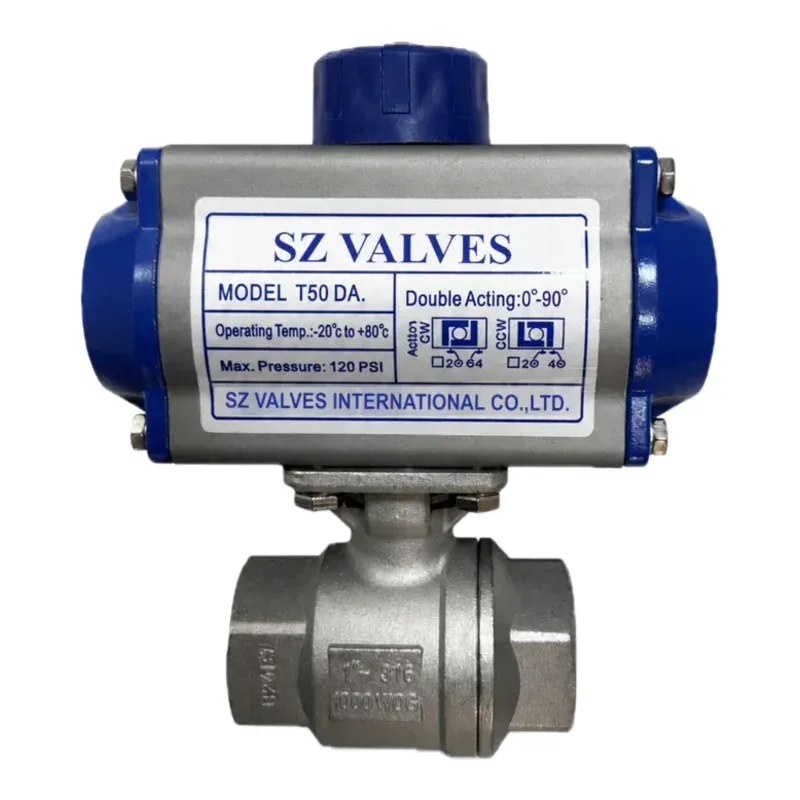
Temperature is the one point the pad does not settle. The V-2AM's valve body is rated to 180°C, while the standard actuator is rated −20°C to +80°C, so on a hot line the assembly follows the actuator. Tell us the line temperature and we will confirm the build.
Accessories mount without tubing. Every pneumatic actuator we make has a NAMUR interface, the standard pattern that NAMUR recommendation NE 19 describes for mounting a solenoid valve on a part-turn actuator. Our solenoid valve for pneumatic actuators bolts onto it, a limit switch box reports the open and closed positions to the control system, and a positioner can be added.
Tested: what is checked before a pneumatic ball valve ships?
Before a pneumatic ball valve leaves our plant it is checked as a valve, then as an assembly.
- The valve. Every valve is leak tested and checked dimensionally before it ships: all of them, not a sample from the batch.
- The assembly. Every valve and actuator is assembled and tested before shipment. On the two-piece V-2AM, the three-piece V-3AM, the sanitary V-3NM and the three-way MV-3DM, each assembly is stroke tested, meaning it is run through its full open and closed travel, and torque tested.
- The package. A solenoid valve and limit switch box ordered with the valve are fitted in the plant and tested with it, so there is nothing to match up on site.
Ask for documents when you order. A mill test report for the valve body, the dimension sheet and break torque values for the valve size are available on request. We hold ISO 9001 and CE.
How can you tell a manufacturer from a reseller?
Four questions separate a pneumatic ball valve manufacturer from a company that joins bought-in parts. They are fair questions to put to any supplier, and these are our answers.
- Where is the valve body cast? In our own foundry. Every valve body starts as a wax pattern, and the steps from wax injection to machining are shown with photographs on our home page.
- Who makes the actuator? We do. The rack-and-pinion actuators on these valves are made here, in double acting and spring return, and they can carry your brand.
- What is tested on every unit? Every valve is leak tested, and the assemblies are tested as described above.
- Who controls a change to the design? The pattern tooling, the casting and the assembly stay in this plant, so a thread, a marking or a build to your drawing is decided here. We can sign an NDA before you send the drawing.
For private label we offer laser marking, stamping, labels and printed cartons to your artwork, and the OEM page shows how a program runs. If you are sourcing castings and not finished valves, start with our guide to valve casting manufacturers.
What do we need to quote a pneumatic ball valve?
Send the build, the size, the action and the air supply, and we can quote a pneumatic ball valve as one line with its actuator. The full list:
- Build and size: two-piece, three-piece, flanged, sanitary, vacuum or three-way, with the quantity of each.
- End connection: the thread standard (PT, NPT or PF), socket weld or butt weld, the flange standard (ASME Class 150 or 300, JIS 10K or 20K), Tri-Clamp, or NW50.
- Body material: CF8M (cast 316) or CF8 (cast 304).
- Action: double acting or spring return, and for spring return the fail direction, open or closed.
- Air supply: the lowest pressure available at the valve, and the highest if it can go above 8 bar.
- Line conditions: the medium, the operating pressure and temperature, and how often the valve cycles.
- Accessories: a solenoid valve with its coil voltage (24V DC, 110V AC or 220V AC), a limit switch box, a positioner.
- Marking and documents: your brand, a mill test report, the dimension sheet.
Minimum order depends on the model and the marking, so it is settled in the quote. Samples are available and charged for.
Common mistakes on pneumatic ball valve orders
Four details are easy to leave off a pneumatic ball valve inquiry, and each one changes what gets built.
1. Leaving the fail direction or the solenoid function for later
A spring return actuator is built to the fail direction on the order, and the solenoid valve follows the actuator: 5/2 for double acting, 3/2 for spring return. Put both on the inquiry. The reasoning is in our 3-way guide, and it applies to two-way valves as well.
2. Giving the compressor pressure instead of the pressure at the valve
The actuator has to work at the lowest supply pressure it will see. That is the pressure at the valve when the plant air system is under load, not the setting on the compressor. Give us that number.
3. Naming an actuator model instead of the duty
A model number copied from an old valve was chosen for that valve and that air supply. Describe the duty instead, with the air pressure at the valve, the fail mode and how often the valve cycles, and the plant sizes the actuator to it.
4. Leaving out the thread or flange standard
PT and NPT are different thread standards, and ASME and JIS flanges do not bolt together. A valve built to the wrong standard will not make up to the pipe. Name the standard for every line item.
FAQ
Who makes pneumatic ball valves in Taiwan?
SZ Valves is a pneumatic ball valve manufacturer in Taichung, Taiwan, and has made valves in the same plant since 1995. We cast the stainless bodies in our own foundry, make the rack-and-pinion actuators, and ship the valve and actuator as one tested assembly. The range covers two-piece, three-piece, flanged, sanitary, vacuum and three-way builds, from 1/4″ to 4″ depending on the build.
Does the quote for a pneumatic ball valve include the actuator?
Yes. Our quote covers the valve with its actuator, sized in the plant for your air supply and line conditions. A solenoid valve, a limit switch box and a positioner are options added to that assembly. You do not need to name an actuator model; state double acting or spring return, the fail direction, and the lowest air pressure at the valve.
When are the actuator type and fail position set?
At the factory, from the order. The plant builds and tests the assembly to the action and fail position on the order, so put both on it: double acting or spring return, and for spring return whether the valve must fail open or closed.
What is tested before a pneumatic ball valve ships?
Every valve is leak tested and checked dimensionally, and every valve and actuator is assembled and tested before shipment. On the V-2AM, V-3AM, V-3NM and MV-3DM, each assembly is also stroke tested and torque tested. A mill test report for the valve body, the dimension sheet and break torque values are available on request.
Can you supply pneumatic ball valves under our brand, and is there a minimum order?
Yes. We mark the valves and actuators with your brand by laser marking, stamping or labels, and pack them in printed cartons to your artwork. Minimum order depends on the model and the marking, so it is settled in the quote. Samples are available and charged for.
Summary
SZ Valves makes the valve body, the actuator and the assembly in one plant in Taichung. That is what lets us size the actuator against our own valve, mount it directly on the valve's ISO 5211 pad, and ship the pair as one tested assembly. To get a quote, send the build, size, end connection, action with fail direction, air supply and line conditions. If all you have is a part number, a spec sheet or a photo, send that and we will work from there.