

Short answer: SZ Valves is a 3 way ball valve manufacturer in Taichung, Taiwan, and has made valves since 1995. We build stainless steel three-way ball valves with an L-port or a T-port ball in four builds: manual threaded, pneumatic actuated, Tri-Clamp sanitary and KF vacuum, from 1/4″ to 2″. The threaded bodies are investment-cast in our own foundry in CF8M, the cast form of 316, and every valve is leak tested before it ships.
A buyer searching for a 3 way ball valve manufacturer usually has the flow path worked out already. One line has to switch between two tanks, or two streams have to become one. What is left to settle is the supplier. Which bores does the plant make? In which end connections and sizes? Does the actuated version arrive assembled, and what was tested before it left?
This page answers those questions for our plant: the four builds we make, what they are made of, how to choose between them, what is tested, and what to send for a quote. One neighboring topic has its own guide and is only summarized here: double acting or spring return on a pneumatic 3-way ball valve.
What does a 3 way ball valve manufacturer make?
A three-way ball valve has a third port in the body, so one valve does what usually takes two shut-off valves and a tee: switch between two lines, divert flow, or blend two streams into one. Making it takes more than adding a port. The plant has to make the ball in two bores, L-port and T-port, build the valve around the bore the order names, and, for an automated valve, mount an actuator on top and test the two together.
At SZ Valves the body, the ball and the assembly come from one site in Longjing, Taichung, Taiwan. The plant has made valves since 1995 and runs its own foundry, its own machining and its own actuator assembly. We build to your print, in small runs or as an OEM program.
Which 3 way ball valves does SZ Valves make?
The table lists our four three-way builds with the model, end connection, sizes and operation of each, taken from the product pages. Each build name links to its page. Every build is offered with an L-port or a T-port ball.
| Build | Model | End connection | Sizes | Operation |
|---|---|---|---|---|
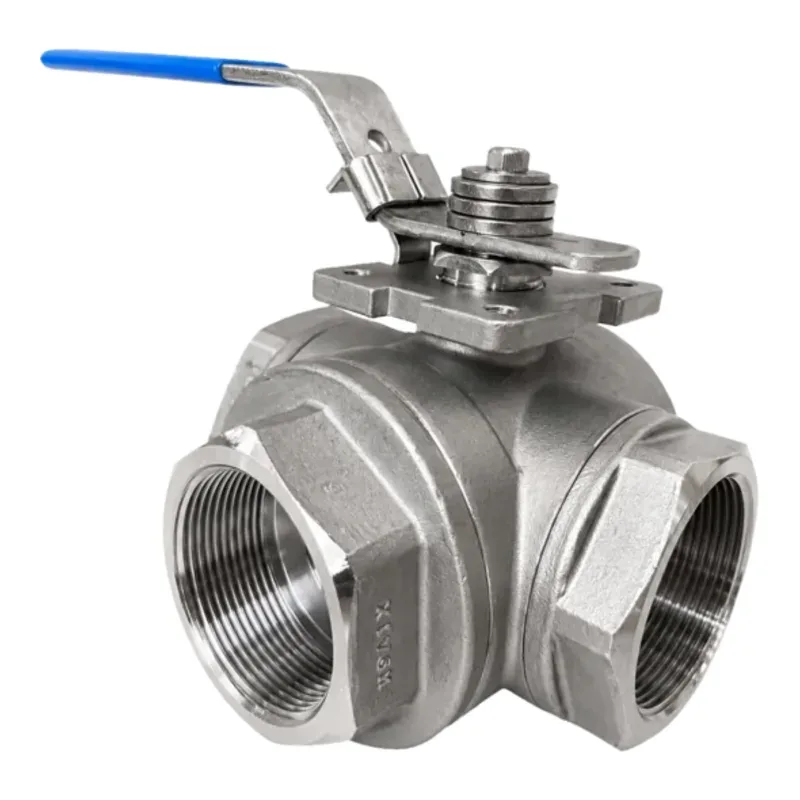
| Manual, threaded | MV-3M | Threaded: PT (tapered), NPT or PF (parallel) | 1/4″ to 2″, eight sizes | Latch-lock lever, with an ISO-style mounting pad under it |
| Actuated, threaded | MV-3DM | Threaded: PT, NPT or PF | 1/4″ to 2″, eight sizes | Rack-and-pinion pneumatic actuator, double acting or spring return |
| Sanitary, Tri-Clamp | MV-3N (manual), MV-3M-TC (pneumatic) | Tri-Clamp | 1/2″ to 2″, five sizes | Manual lever, or a pneumatic actuator on an ISO 5211 pad |
| Vacuum, KF | V-3WV (manual), plus a pneumatic build | KF (NW) clamp flanges | NW40 (1-1/2″) and NW50 (2″) | Lever with a locking plate, or a pneumatic actuator, on the same ISO 5211 pad |
The threaded and Tri-Clamp builds are rated 1000 WOG. That is a cold working pressure rating for water, oil and gas, not a steam rating. The pneumatic builds run on a rack-and-pinion actuator, double acting or spring return, on an air supply of 4 to 8 bar (about 60 to 116 psi).
What is a 3 way stainless steel ball valve made of?
The answer differs a little by build, so here it is model by model.
- Threaded MV-3M and MV-3DM. On the MV-3M the body, the caps and the ball are investment-cast in CF8M, the cast form of 316, with PTFE seats and an SS316 stem. The actuated MV-3DM is cast in the same CF8M with the same PTFE seats. CF8 (cast 304) is made to order on both. With PTFE seats the valve bodies of these two models are rated −20°C to 180°C. Threads are cut to the standard stated on the order: PT, NPT or PF.
- Tri-Clamp MV-3N and MV-3M-TC. These are 316 stainless steel with a sanitary polish. The PTFE seat comes two ways. An encapsulated seat closes off the dead space around the ball and runs −20°C to 80°C. A semi-encapsulated seat runs −20°C to 180°C and suits hot water and hot process lines. Those are seat ratings; on the pneumatic build, tell us the line temperature and we will confirm the build.
- KF vacuum valve. The body is cast in CF8M and polished, with PTFE seats and a full-port bore: Ø38 on NW40 and Ø46 on NW50. The valve body is rated −20°C to 180°C, and CF8 is available to order.
L-port or T-port: which ball goes in the valve?
The bore through the ball is the one difference between the two, and it cannot be seen from outside. An L-port is the diverting ball: on our threaded valves it joins the bottom port to one side port or the other. A T-port is the mixing and distributing ball: it can run straight through, feed a branch, or bring two inlets into one outlet. Pumps & Systems draws the same line in its article on three-way valve applications, with the L-port as the diverting pattern and the T-port as the one mostly used for mixing.
We make both. L-port and T-port are both stock builds on the manual MV-3M, and both are offered on the other three builds. The bore is built into the valve at the factory, so name it in the inquiry.
A three-way ball valve switches flow between ports, and neither bore has a fully closed position. Where a branch must be shut tight, add a two-way valve downstream. For an actuated valve, our 3-way guide shows how a 90° actuator maps onto each bore.
Manual, actuated or sanitary: how do you choose the build?
Start from how the valve will be turned and what the line carries.
An operator turns the valve at the line
Take the manual MV-3M. It has a latch-lock lever, and an ISO-style mounting pad sits under the lever, so a quarter-turn actuator can be fitted later without a bracket or linkage. That actuator can be ordered from us.
The valve has to switch on a signal
Take the actuated MV-3DM. It ships with the rack-and-pinion actuator already mounted. The body is machined with two ISO 5211 bolt patterns, the international standard for attaching part-turn actuators to valves, so the actuator sits straight on the valve with no bracket and no coupling. Double acting holds its last position if the air supply drops. Spring return goes back to the port you nominate on the order. A solenoid valve, a limit switch box or a positioner can be added for control.
The line is hygienic and comes apart for cleaning
Take the Tri-Clamp valve. Undo the clamps and the valve comes off the line; undo the body bolts and the ball and seats come out for inspection between batches. Choose the seat by line temperature: the encapsulated seat runs to 80°C and the semi-encapsulated seat to 180°C. Then decide manual or pneumatic when you order. The pneumatic MV-3M-TC ships with its actuator factory-mounted on an ISO 5211 pad, so it is the build to order for any point that will have to divert on a signal. Tell us the line temperature and we will confirm the build.
The line is under vacuum
Take the KF valve in NW40 or NW50. One quarter turn switches a vacuum pump from one chamber to the other, or opens a line to atmosphere. The KF flanges close with a clamp and a centering ring, with no bolts, so the valve comes off the line in seconds. The manual and pneumatic builds share the same body, flanges and seats. A vacuum equipment maker in Singapore, for example, ordered the manual V-3WV to fit on its own equipment.
What is tested before a 3 way ball valve ships?
Each valve is checked as a valve first, then as an assembly if it carries an actuator.
- The valve. Every valve is leak tested and checked dimensionally before it ships: all of them, not a sample from the batch.
- The assembly. Actuated valves are assembled and tested in the plant. On the threaded MV-3DM and the Tri-Clamp MV-3M-TC, each assembly is stroke tested, meaning it is run through its full travel between its two positions, and torque tested.
- The package. A solenoid valve and limit switch box ordered with the valve are fitted in the plant and tested with it, so there is nothing to match up on site.
Ask for documents when you order. A mill test report for the valve body, the dimension sheet and torque values for the valve size are available on request. We hold ISO 9001 and CE.
What should you ask a 3 way ball valve manufacturer?
Four questions sort a manufacturer from a company that joins bought-in parts. They are fair questions for any supplier, and these are our answers.
- Where is the body cast? The threaded and KF bodies are cast in our own foundry. Every cast body starts as a wax pattern, and the steps from wax injection to machining are shown with photographs on our home page.
- Do you make both bores, and who confirms the porting? We make L-port and T-port balls for all four builds. Send the flow path and the plant confirms the porting before the valve is built.
- Who makes and mounts the actuator? We do. The rack-and-pinion actuators are made here, mounted here and tested with the valve, and they can carry your brand. Our guide to choosing a pneumatic ball valve manufacturer explains how the actuator is sized.
- What can be set for my order? The thread standard, the body grade, the marking, or a build to your drawing. The casting, machining and assembly stay in this plant, so a change is decided here, without waiting on another supplier. We can sign an NDA before you send the drawing.
For private label we offer laser marking, stamping, labels and printed cartons to your artwork. On lever valves the handle sleeve can carry your brand as well. The OEM page shows how a program runs.
What do we need to quote a 3 way ball valve?
Send the build, the size, the bore and the end connection, and we can quote. The full list:
- Build, size and quantity: manual threaded, actuated threaded, Tri-Clamp or KF vacuum.
- Bore: L-port or T-port, with a sketch of the flow path if you have one. For an actuated T-port valve, name the two flow patterns it has to give you.
- End connection: the thread standard (PT, NPT or PF), Tri-Clamp, or NW40 or NW50.
- Body material on threaded and vacuum valves: CF8M (cast 316), or CF8 (cast 304) to order.
- Operation: manual or pneumatic. For pneumatic, double acting or spring return, the port the valve must return to on air loss, and the lowest air pressure at the valve.
- Seat on Tri-Clamp valves: encapsulated or semi-encapsulated, with the line temperature.
- Line conditions: the medium, the operating pressure and temperature, and, for an actuated valve, how often it cycles.
- Accessories: a solenoid valve with its coil voltage (24V DC, 110V AC or 220V AC), a limit switch box, a positioner.
- Marking and documents: your brand, a mill test report, the dimension sheet.
Minimum order depends on the model and the marking, so it is settled in the quote. Samples are available and charged for.
Common mistakes on 3 way ball valve orders
These details are easy to leave off a three-way inquiry, and each one changes what gets built.
1. Asking for a 3-way valve without naming the bore
An L-port and a T-port valve look the same from outside and do different jobs. Name the bore on every line item, or send the flow sketch and we will confirm it.
2. Leaving the shut-off valve off the drawing
A three-way ball valve is a switching valve. Where a branch has to be isolated for maintenance, draw a two-way valve downstream of it from the start.
3. Deciding manual or pneumatic after the Tri-Clamp valve is ordered
On the Tri-Clamp valve the manual and pneumatic builds are separate models, chosen at order time. If the point may be automated, order the pneumatic MV-3M-TC.
4. Leaving out the thread standard or the line temperature
PT and NPT are different thread standards, so state the one the rest of the line uses. On a Tri-Clamp valve the line temperature decides the seat. Put both on the inquiry.
FAQ
Who makes 3 way ball valves in Taiwan?
SZ Valves is a 3 way ball valve manufacturer in Taichung, Taiwan, and has made valves in the same plant since 1995. We make stainless steel three-way ball valves in four builds: manual threaded, pneumatic actuated, Tri-Clamp sanitary and KF vacuum. Sizes run from 1/4″ to 2″, and every build is offered with an L-port or a T-port ball.
What is the difference between an L-port and a T-port 3 way ball valve?
An L-port ball diverts: it sends flow to one outlet or the other. A T-port ball can run straight through, split one inlet to a branch, or bring two inlets into one outlet for mixing. The two valves look the same from outside, so the bore has to be named on the order. Send a flow sketch and we will confirm which one fits.
Can a manual 3 way ball valve be automated later?
Yes, on the threaded MV-3M. An ISO-style mounting pad sits under the lever, so a quarter-turn actuator can be fitted later without a bracket, and the actuator can be ordered from us. If you want the valve and actuator delivered as one tested unit, order the actuated MV-3DM. On a Tri-Clamp line, order the pneumatic MV-3M-TC for any point that will be automated.
What sizes and end connections do your 3 way ball valves come in?
Threaded valves come in eight sizes from 1/4″ to 2″, cut to PT, NPT or PF. Tri-Clamp sanitary valves come in five sizes from 1/2″ to 2″. Vacuum valves come with KF clamp flanges in NW40 (1-1/2″) and NW50 (2″). The threaded and Tri-Clamp valves are rated 1000 WOG.
Can you supply 3 way ball valves under our brand, and is there a minimum order?
Yes. Private label covers the valve and, on actuated builds, the actuator: your brand by laser marking, stamping or labels, with printed cartons to your artwork. The minimum order depends on the model and the marking and is settled in the quote. Samples are available and charged for.
Summary
SZ Valves makes three-way ball valves in one plant in Taichung: manual threaded, pneumatic actuated, Tri-Clamp sanitary and KF vacuum, each with an L-port or a T-port ball. To get a quote, send the build, size, bore, end connection and, for an actuated valve, the action with its fail port and the air supply. If all you have is a part number, a spec sheet or a photo, send that and we will work from there.