
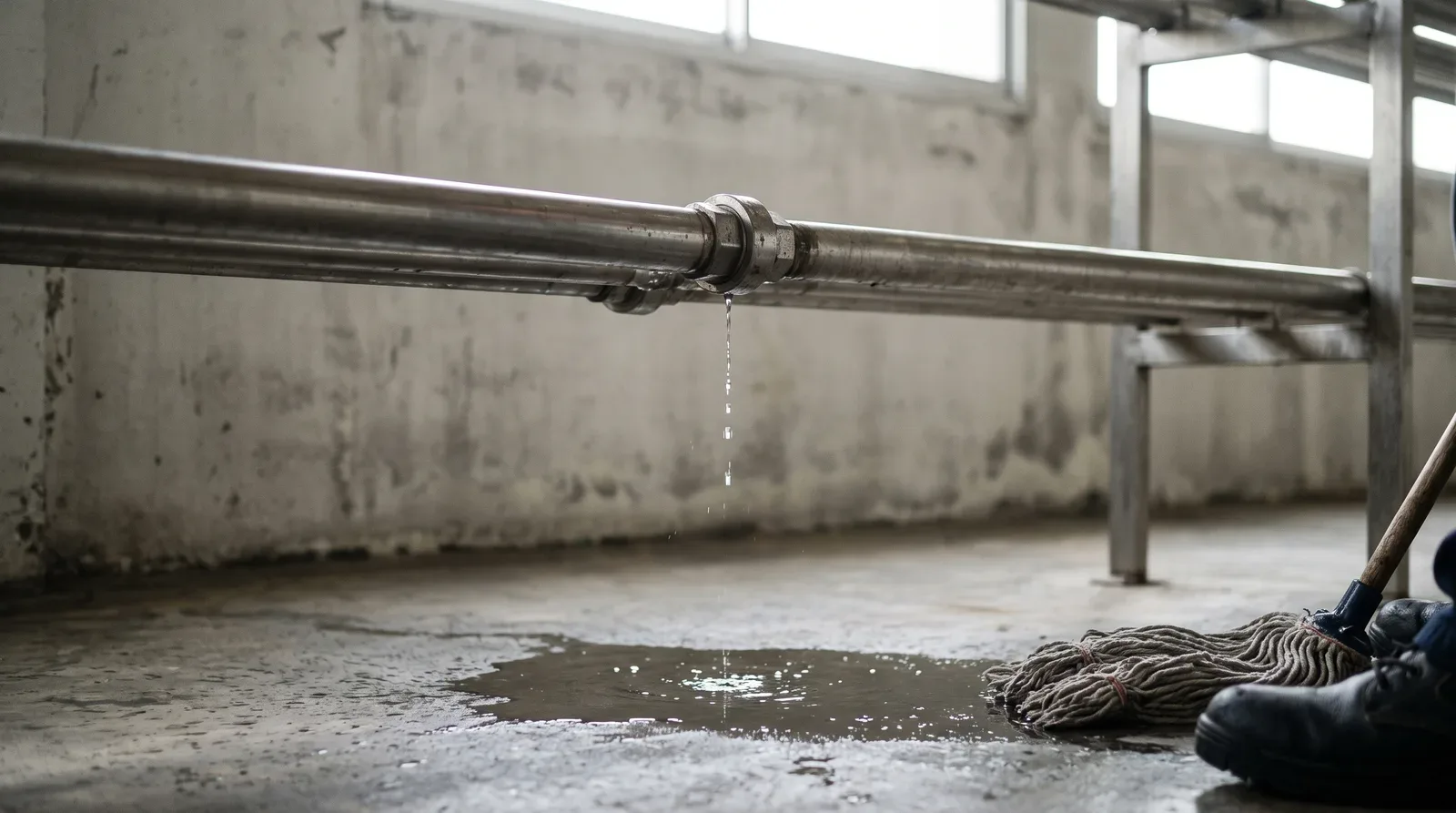
When a cheap stainless steel check valve leaks, the cause is often something skipped before installation: the right grade for the water, a properly finished seat, or a size and type that suit the line. Name the mill test report, the seat leakage class and the installation conditions on the purchase order, and add downtime to the price comparison.
Choosing between a check valve and a ball valve is covered in our check valve vs ball valve guide. This article is for the next step: the valve is going in, and you want it to hold.
Key takeaways
- 304 and 316 look identical. 316 carries roughly 2 to 3% molybdenum, which is what resists chloride pitting. The certificate and the model number tell you what was ordered; a molybdenum spot test or a spectrometer (PMI) check tells you what arrived.
- "Pressure tested" does not mean "does not leak". ISO 5208 grades seat tightness from Rate A to Rate G, and API 598 lists a separate allowance for metal-seated check valves. The spec should name the standard and the class, not just ask for a test.
- A swing check closes by gravity, so it belongs in a horizontal run or a vertical run with upward flow, and the U.S. Department of Energy Fundamentals Handbook on mechanical science advises against it in pulsating flow. A spring check closes on the spring and tolerates more orientations, at the cost of a little pressure to open it.
- Low flow wears a check valve out early: the disc never reaches full open, flutters and wears the seat. A 1986 U.S. Nuclear Regulatory Commission notice records this failure, and an oversized valve creates the same low-flow condition.
- Annualized cost of ownership = (valve price + replacement labor + downtime loss) ÷ expected service years + yearly maintenance. Run it for each position before comparing quotations.
A check valve leaks where it closes
Most check valves have no handle. The flow pushes the disc open; gravity, back pressure or a spring pushes it shut. Since the whole job depends on one motion, the disc landing on the seat, the leak paths are predictable.
- The seat face. A seat that was not ground flat, a seat scratched by debris, or a seat pitted by chloride all leak here.
- The bonnet or cap gasket. Poor gasket material or uneven bolt load leaks to the outside.
- The hinge pin. A worn or corroded pin lets the disc hang crooked, so it never lands square.
- The casting itself. Sand inclusions and micro-shrinkage weep under pressure. A 2014 paper by the Steel Founders' Society of America and the University of Iowa describes a batch of 22 stainless cast valve bodies in which 9 leaked at the gasket face after machining; sectioning showed micro-porosity that radiography had not caught.
Those four places are also where a low-cost valve saves money: seat grinding, gasket material, pin material, casting inspection. None of it shows from the outside, and the valve holds on day one; the trouble starts after some months in service.
| Type | How it closes | Seat | Orientation | Closing speed and slam | What cheap versions skimp on |
|---|---|---|---|---|---|
| Swing check | Disc on a hinge, closed by gravity and reverse flow | Metal to metal, or a metal seat with a composite disc face | Horizontal run, or vertical with upward flow | Slow to close; the reverse surge at pump trip is felt | Hinge pin material, seat grinding |
| Spring check (silent check) | Spring pushes a piston or disc onto the seat | Metal to metal or soft seat | Does not depend on gravity; follow the maker's data | Fast; less slam | Spring material (rust, fatigue) |
| Lift check | Disc rises and falls on a guide; flow enters under the seat | Metal seat, can be re-lapped | Horizontal run, or vertical with upward flow | Moderate | Guide fit |
| Dual plate (wafer) check | Two half-discs on torsion springs | Soft or metal | Follow the maker's data; mounts between two flanges | Fast | Springs and pins |
The rest of this article leans on swing and spring checks, because those are the two types we cast. How to choose between them for a given line is covered in the check valve vs ball valve article, so it is not repeated here.
Stainless steel check valve material: 304 and 316 look the same
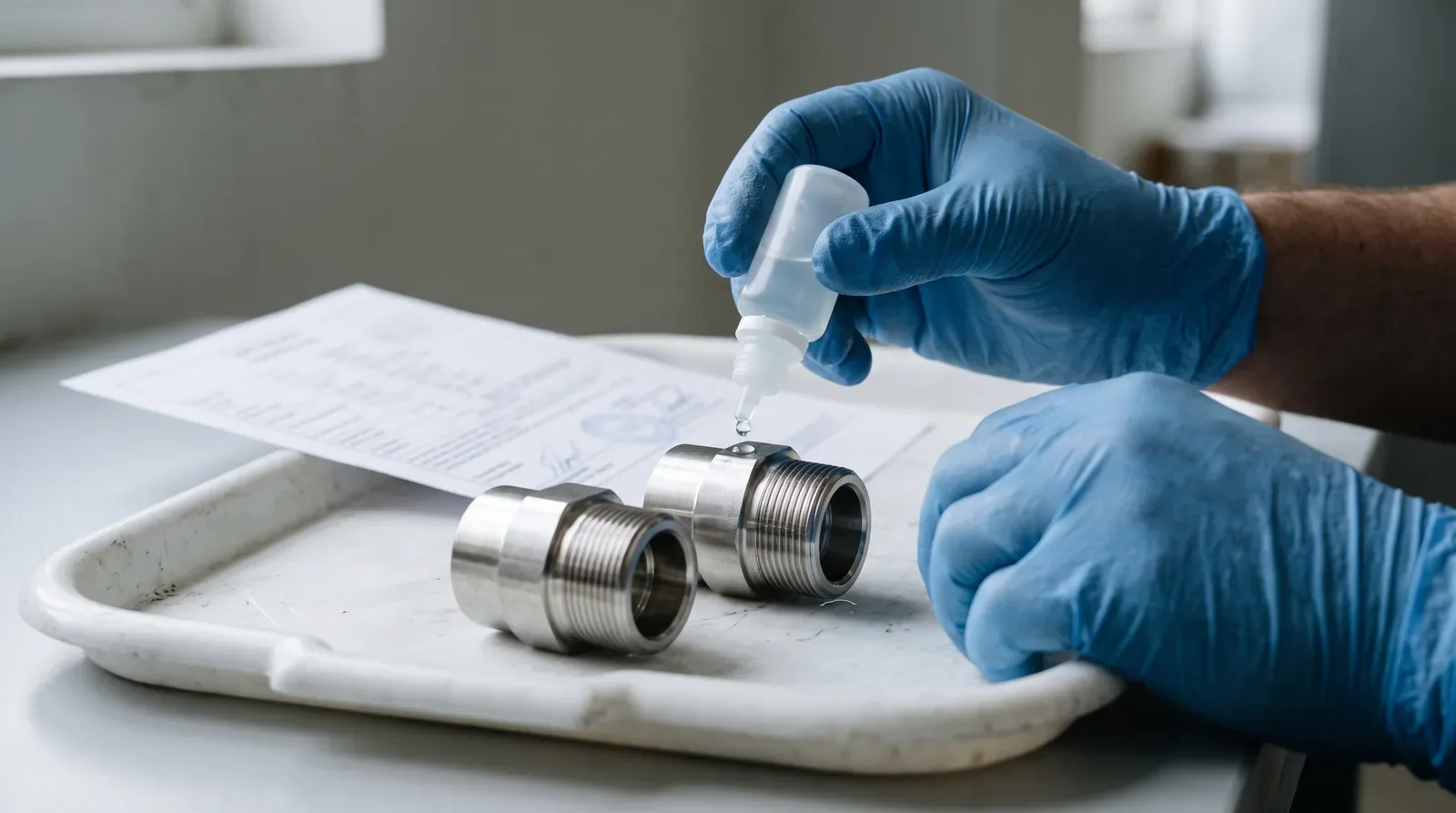
One of the common problems with a low-cost stainless check valve is the grade: a valve sold as 304 that is really 201, or a 304 valve installed where the water calls for 316. Neither leaks on day one. Both commonly start with a pit in the seat face and a weep that grows from it.
Molybdenum is what 316 adds
Both grades are austenitic stainless steels. 316 adds about 2 to 3% molybdenum, and molybdenum is what raises resistance to chloride pitting. So the question is not whether the service is "harsh" but whether chloride is present.
Some reference points. The U.S. EPA sets a non-enforceable secondary standard of 250 mg/L for chloride in drinking water, based on taste, and a maximum residual disinfectant level of 4.0 mg/L for chlorine. Guidance for stainless steel varies by source: the Nickel Institute figures quoted by the Australian Stainless Steel Development Association (ASSDA) put 304 at roughly 200 mg/L chloride and 316 at roughly 1000 mg/L; a Power Engineering article on heat exchanger materials by Buecker and Janikowski is more conservative, at 150 mg/L for 304 and 400 mg/L for 316. The sources assume different water chemistry and test conditions, so treat the numbers as guides rather than limits. Ordinary municipal water usually sits inside the 304 range. Three services push it out:
- Cooling towers. Make-up water is evaporated over and over, and chloride concentrates with it. The same Power Engineering article gives an example: 50 mg/L chloride in the make-up becomes 250 mg/L at five cycles of concentration, which the authors say usually rules 304 out.
- Coastal plants. Salt spray collects on the body and the threads and pits them from the outside. Where the valve stays damp and salty, specify 316.
- Seawater. Seawater carries roughly 19,000 mg/L chloride, about 75 times the EPA's 250 mg/L drinking-water guideline. 304 is not a candidate, and 316 only lasts longer; talk to us before putting either in continuous seawater service.
Bleach and chlorine-based cleaning solutions are a separate case. That is free chlorine, an oxidizer, not chloride ion. The same Nickel Institute guidance gives 304 about 2 ppm and 316 about 5 ppm of continuous free chlorine exposure, and at higher concentrations 316 corrodes as well. Treated drinking water normally carries far less than the 4.0 mg/L ceiling; ASSDA puts the usual residual at 0.2 to 0.5 mg/L. If a line carries chlorinated sanitizer, tell us the concentration first.
Pitting is local. The valve can look fine while one pit in the seat face is enough to stop it sealing.
201 sold as 304
Grade 201 replaces part of the nickel with manganese. It costs much less, and most sources rate its corrosion resistance below 304, especially in damp or chloride-bearing service. The trouble is that it looks identical, and a magnet does not help: annealed 200-series and 300-series steels are both non-magnetic, and 304 can pick up slight magnetism after cold work. When ASM International interviewed a manufacturer with a plant in China in 2017, he called 201 "the classic fake for 304" and said that when his company first tested incoming metal in China, about two-thirds of the stainless was nonconforming or fake. That is one company's experience, not a market survey, but it is why grade verification belongs on the purchase order as a line item.
CF8 and CF8M are casting grades, and they describe the body only
A valve body is a casting, so the grade on the drawing is a casting grade: CF8 is cast 304 and CF8M is cast 316. Check that the same grade is marked on the body. A CF8M body does not mean the disc, the spring and the hinge pin are 316. Read the material certificate by part, not just the body line.
| Service | Grade | Why |
|---|---|---|
| Municipal water, compressed air, general industrial water | 304 (cast grade CF8) | Low chloride |
| Cooling tower circulation | 316 (cast grade CF8M) | Chloride concentrates with each cycle |
| Seawater, coastal salt spray | 316 (cast grade CF8M); confirm with us for continuous seawater | High chloride |
| Unknown water | Get a water analysis first | Price is not a material selection method |
Three checks at purchase: ask for the mill test report (MTR) and read it against the parts list; make sure the model number, the certificate, the quotation and the mark cast on the body all agree; and do not accept "it should be 304". For a definitive answer, send a sample for spectrometer analysis (PMI) or use a molybdenum reagent spot test.
Check valve specification: seat leakage class and what a pressure test proves
Valves made to the common standards are pressure tested before they ship, and those standards allow a metal-seated check valve to leak a measured amount and still pass. The specification has to name the standard and the class.
How ISO 5208, EN 12266-1 and API 598 grade a seat
ISO 5208, the pressure test standard for metallic valves, sorts seat leakage into ten rates from A to G. Rate A means no visible leakage for the duration of the test. Every rate after it allows a volume that scales with the nominal size DN. For a liquid test, Rate B allows 0.01 × DN cubic millimeters per second and Rate G allows 2 × DN. A DN 50 valve at Rate G can pass while leaking 6 milliliters a minute. EN 12266-1 uses the same A to G scale without the AA, CC and EE intermediate rates.
API 598 grades by seat material instead. Resilient (soft) seats must show no visible leakage. Metal seats get an allowance by size, and check valves get their own, larger column: metal-seated check valves up to 2 inches may leak 6 cc per minute, 4-inch valves 12 cc per minute. On the same table, a 4-inch metal-seated valve of any other type is allowed 8 drops per minute, under 1 cc. MSS SP-61 also treats check valves separately: their allowed leakage can be four times that of other valves.
| Standard | How it grades | Check valve test requirement | What the spec should say |
|---|---|---|---|
| ISO 5208 | Rate A (no visible leakage) to Rate G; allowance scales with DN | DN 50 and below: minimum 60 s hold for check valves, 15 s for others; DN 65 and above: 60 s for all, 120 s from DN 200 | Which rate the valve is accepted to |
| EN 12266-1 | Rates A to G, no AA, CC or EE | Same rate scale as ISO 5208 | Same |
| API 598 | Soft seat: no visible leakage; metal seat: allowance by size, check valves listed separately | Low-pressure closure test optional, high-pressure closure test required | Soft or metal seat; every valve or sample |
The standards themselves are paid documents. The figures above come from several technical reprints that agree with each other. If a number goes into a purchase specification, ask the supplier which edition they test to.
Soft seat or metal seat
A soft seat (PTFE, for example) seals well enough to pass with no visible leakage, but it can be scored by debris and it wears. A metal-to-metal seat resists wear and media, but it is allowed to leak a little from the start, and wear only adds to that. A common shortcut is a metal seat that was never ground, so the leakage starts high.
Five lines on the spec make "tested but leaking anyway" much less likely:
- Which standard: API 598, ISO 5208, EN 12266-1, or the factory's own procedure?
- Seat test medium, pressure and hold time?
- Acceptance leakage class or allowable leakage?
- Every valve tested, or a sample? Is a report available?
- Soft seat or metal seat, and what is the soft seat material?
Five mistakes that leave a check valve leaking
None of these five is a defect in the valve. Each is one step skipped at purchase or installation, and each has a fix you can apply on the next order.
1. Comparing unit prices without the certificates
Two quotations, one noticeably cheaper, both with "304" in the material column. The difference may be that one comes with a mill test report and the other does not. Fix: ask for the certificate at quotation stage, read it by part, and check that model, certificate, quotation and body mark agree.
2. Treating the pressure test as a leak-free guarantee
"Every valve is tested" sounds reassuring, but the standards allow a metal-seated check valve to leak within limits. Fix: put the standard, the class, and "every valve" or "sample" on the spec, rather than "must pass pressure test".
3. Check valve sizing done from the pipe size
A disc needs enough velocity to lift to full open. Short of that, it hovers half open and flutters, wearing the seat and the hinge pin. The U.S. Nuclear Regulatory Commission's Information Notice 86-09 records this failure: flow too low to hold the discs up, discs chattering and wearing, a guide stud broken, a disc jammed part open and unable to close. An oversized valve creates the same low-flow condition. The same valve on a line with adequate flow lasts; on a line with too little, it leaks after a stretch of service. Fix: size to the actual flow rate, and ask the supplier whether a smaller size suits the flow.
4. Wrong type or wrong orientation
A swing check closes by gravity. Installed in a vertical line with downward flow, nothing helps it close; it waits for reverse flow to push the disc back, closes late and seals poorly. Installed on a reciprocating pump or compressor discharge, the disc follows the pulsation and hammers the seat; the U.S. Department of Energy Fundamentals Handbook states that swing checks should not be used in pulsating flow. At pump trip a swing check closes slowly, reverse flow builds first, and the slam you hear is the disc being driven home. Fix: use a spring check where the flow pulses or the valve must close fast; install to the arrow on the body; confirm the allowed orientation before putting any check valve in a vertical line.
5. No strainer upstream, no spare on the shelf, no record
Weld spatter, swarf and scale caught on the seat are a common reason a new valve leaks from the first day, and no grade of stainless fixes that. Fix: install a Y strainer upstream, keep a spare for critical positions such as pump discharge and tank inlet, and log the install date and the service for each valve so the next order has data behind it.
Cost of ownership: the price gap is rarely the biggest number
When a check valve fails, the bill can include the pump running backwards, water hammer damaging pipe and instruments, downstream water returning upstream, and a line stopped for the change-out. Only when those are counted does the gap between a cheap valve and a documented one (the "compliant valve" below) show up.
The U.S. EPA Cross-Connection Control Manual records a backflow case from 1984: at a New Mexico high school, boiler anti-corrosion chemical passed through leaking check valves on the boiler feed lines into the drinking water, and the school closed for several days. The pump life cycle cost guide published by the U.S. Department of Energy with the Hydraulic Institute and Europump makes the general point: for high-usage pumps, the purchase price is a small part of the total cost. The same arithmetic applies to the check valve on the discharge.
The formula
Annualized cost of ownership = (valve price + replacement labor + downtime loss per failure) ÷ expected service years + yearly inspection and maintenance
Downtime loss per failure = hours down × value of output per hour + emergency call-out
Worksheet (fill in your own figures, USD)
| Item | Cheap valve | Compliant valve | How to fill it in |
|---|---|---|---|
| Valve price P | From the quotation | ||
| Replacement labor L | Technician hours × rate, including removal, fitting and pressure test (emergency call-out goes in S, not here) | ||
| Downtime loss per failure S | Hours down × value of output per hour, plus call-out | ||
| Expected service years Y | How long the last valve in that position actually lasted; estimate conservatively if there is no record | ||
| Yearly inspection and maintenance M | Inspection hours and consumables | ||
| Annualized cost | (P + L + S) ÷ Y + M | (P + L + S) ÷ Y + M | Subtract one column from the other |
In many plants the price difference is smaller than a single downtime event. What separates the two columns is Y and S: a valve with a short Y brings S with it every time. Where downtime is expensive (main pump discharge, process water supply), the arithmetic favors the documented valve. Where downtime costs nothing (irrigation, a standby line), the cheap valve may be the right buy, provided the grade and the type are right.
How SZ Valves stainless steel check valves line up
SZ Valves has made valves in Taichung, Taiwan since 1995, and casts the bodies in its own foundry. We make three check valves: the SC threaded swing check (1/2″ to 3″, cast CF8M, 200 PSI (WOG)), the 1PC spring check (1/2″ to 2″, cast CF8 or CF8M, PT, NPT or PF threads) and the C series flanged swing check (2″ to 4″, cast CF8 or CF8M, ASME Class 150 or JIS 10K flanges). Standard builds are the SC in CF8M with PT threads, the 1PC in CF8 with PT threads, and the C series in CF8; the other grade and NPT or PF threads are made to order. Full specifications are in the check valve manufacturer article and on the product pages; here is how they line up against the material, sealing and sizing points above.
- Material. The SC body is cast CF8M; the 1PC and C series are cast CF8 or CF8M. All three are poured in our own foundry with the grade cast into the body. A mill test report (MTR) for the body material is available on request. For high-chloride positions such as cooling towers and coastal plants, specify the CF8M build.
- Sealing. Every valve is leak tested and checked dimensionally before it leaves the factory. The SC threaded swing check valve is also tested to API 598. Seat type and test details for each model can be confirmed when you ask for a quotation.
- Type and size. The SC threaded swing check valve and the C series flanged swing check close partly on the weight of the disc, so put the line orientation and the flow direction on the inquiry. The 1PC spring check valve closes on its spring, so it does not rely on gravity, and it is shorter end to end than the SC in the same size, which suits tight spaces. Put the flow rate on the inquiry as well as the pipe size.
- Documents and custom work. Mill test reports and dimensional inspection reports are available on request. We build to customer drawings and supply private-label marking.
FAQ
Why does a check valve that passed its pressure test still leak?
Because the standards allow metal-seated check valves a measured leakage. API 598 and ISO 5208 both set allowances by size; only API 598 soft seats and ISO 5208 Rate A require no visible leakage. Naming the standard and the class on the spec says more than "must pass pressure test".
How do I tell a 304 check valve from a 316 one?
Check the mill test report and the model number first, then confirm the grade with a molybdenum spot test or a spectrometer (PMI) check; eyes and magnets cannot tell them apart. 316 carries roughly 2 to 3% molybdenum for chloride pitting resistance. Choose 316 for cooling towers and coastal salt spray, and ask us about seawater; 304 serves municipal water and compressed air.
Can a check valve be installed in a vertical pipe?
It depends on the type. A swing check closes by gravity, so it suits a horizontal run or a vertical run with upward flow. For downward flow, put the flow direction on the inquiry and confirm the fit with us before ordering. Always install to the arrow on the body.
How often should a check valve be replaced?
There is no fixed interval. It depends on chloride in the water, whether the flow is enough to hold the disc fully open, and whether a strainer protects the seat. Log the install date and service for each valve, and use how long the last one actually lasted as the planning figure for the next.
What do you need from me to quote a check valve?
Type, size, quantity, body material, end connection (PT, NPT, PF or the flange standard) and the line conditions: medium, pressure and orientation. A part number, a spec sheet or a photo of the existing valve works too; send it and we will price it.
The short version
Grade, seat finish and fit to the line decide whether a check valve holds, and none of them shows on a quotation unless the spec asks for it. If you would like us to match a model to your line, send the spec sheet or a photo through the contact page.
Sources
- U.S. EPA, Secondary Drinking Water Standards (chloride 250 mg/L): epa.gov
- U.S. EPA, National Primary Drinking Water Regulations (chlorine MRDL 4.0 mg/L): epa.gov
- ISO 5208:2015, Industrial valves. Pressure testing of metallic valves: iso.org
- Exal Technology, Leak class tests ENT02-19 Rev. 2 (ISO 5208, EN 12266-1, API 598 and MSS SP-61 compared): exal-technology.com
- U.S. Department of Energy, DOE Fundamentals Handbook, Mechanical Science Vol. 2: energy.gov
- U.S. Nuclear Regulatory Commission, Information Notice 86-09: nrc.gov
- U.S. EPA, Cross-Connection Control Manual (EPA 816-R-03-002): epa.gov
- Monroe, Blair and Beckermann, Reducing Leaks in Cast Pump and Valve Bodies using Solidification Simulation (NACE 2014): uiowa.edu
- ASSDA, Chlorine vs chloride: assda.asn.au
- Euro Inox, Performance of Stainless Steels in Waste Water Installations: worldstainless.org
- Buecker and Janikowski, How much chloride? (Power Engineering): power-eng.com
- ASM International, Advanced Materials & Processes, Nov/Dec 2017, Trust But Verify: asminternational.org
- U.S. Department of Energy, Hydraulic Institute and Europump, Pump Life Cycle Costs: energy.gov