
Before ordering a stainless steel Y strainer, confirm the fluid, flow rate, required screen opening, connection standard, operating pressure and temperature, and space for maintenance. Then have the supplier confirm the complete configuration. A pipe size and a mesh number are useful starting points, but they do not tell the supplier everything needed to select the strainer.
For an equipment builder, a distributor, or a maintenance buyer, the practical question is whether the quoted unit will fit the pipework, protect the downstream equipment, and remain serviceable after installation. This guide turns that question into an ordering checklist, with specific notes on the threaded YS series offered by SZ Valves.
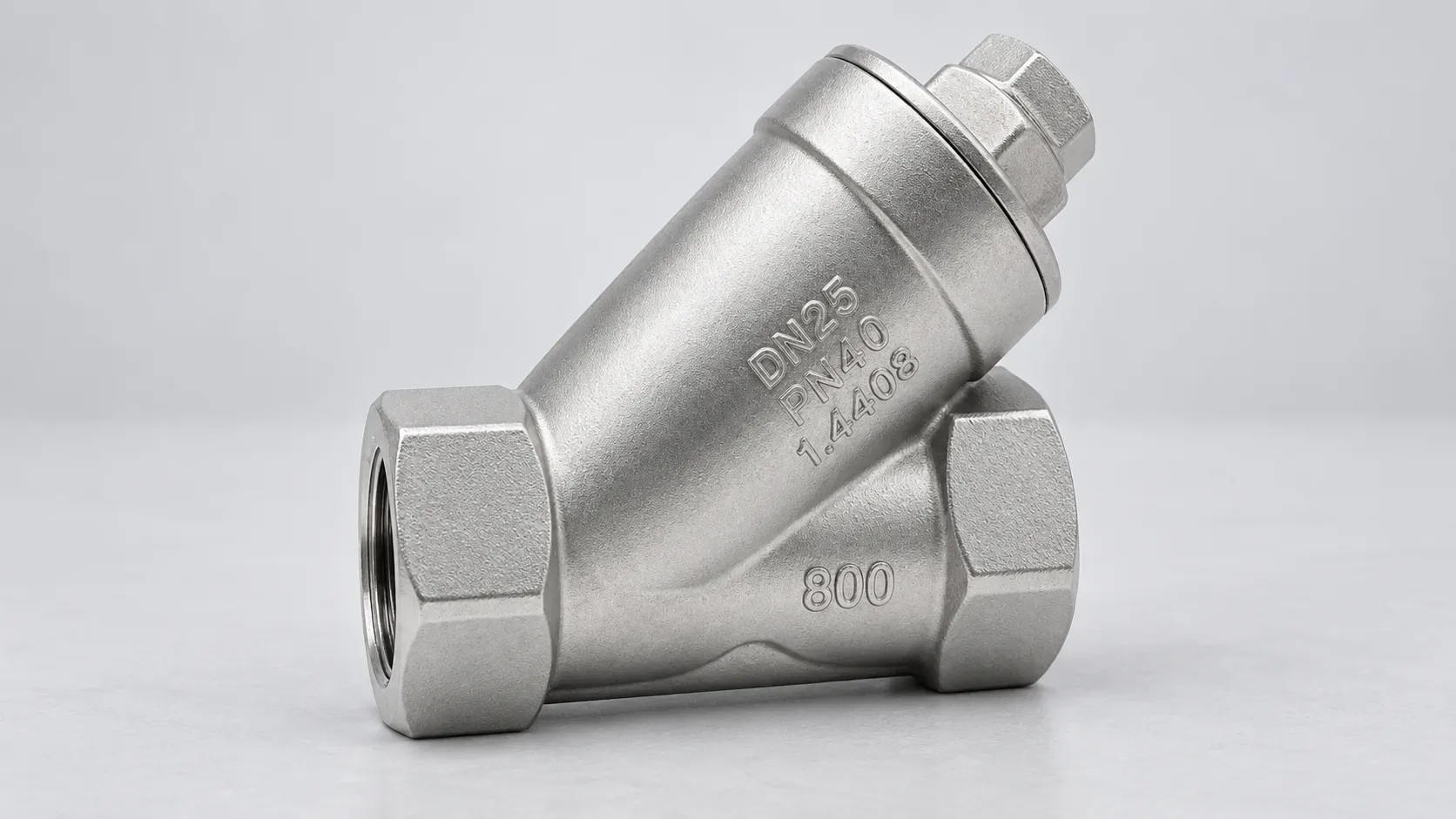
What should you check before ordering a stainless steel Y strainer?
A useful Y strainer specification describes both the operating conditions and the physical connections. State what must be removed from the fluid, how much pressure loss the system can accept, and how the screen will be accessed. Ask the supplier to identify any missing information before you approve the quotation or release the purchase order.
| Check | Information to provide | What the supplier should confirm |
|---|---|---|
| Service fluid | Fluid name, composition, concentration, and cleaning chemicals | Compatibility of the body, screen, seals, and other wetted parts |
| Flow and size | Pipe size, normal and maximum flow, and allowable pressure loss | Size and pressure-drop data for the proposed screen and fluid |
| Screen | Required particle retention or maximum opening | Aperture, mesh, wire or screen construction, and available options |
| Connections | Exact thread standard, nominal size, and mating connection | Thread compatibility, sealing arrangement, and dimensions |
| Operating limits | Normal and design pressure and temperature, including relevant transients | Allowable pressure at the specified temperature |
| Maintenance | Orientation, access space, isolation arrangement, and cleaning needs | Screen-removal clearance, cleaning procedure, and replacement parts |
| Order requirements | Quantity, destination, required documents, and delivery target | Quoted configuration, availability, lead time, and document scope |
If a field is unknown, identify it as an open question in the enquiry. For example, ask the supplier to propose a screen after reviewing the downstream equipment requirement. Leaving the field blank can result in a default configuration being quoted, even when that default does not match the intended duty.
What does a Y strainer do, and is it the right type?
A Y strainer is an inline device that captures solid debris in a removable screen housed in the angled leg of its body. Its purpose is to protect downstream equipment from particles carried by the fluid. It is not a substitute for specifying a filtration process when the requirement concerns dissolved substances, microbiological quality, or a validated final cleanliness level.
The name describes the body shape. You may also see the spelling wye strainer; that spelling alone does not identify a different screening principle. For purchasing, the useful distinctions are the screen opening, available screen area, connections, materials, operating limits, and maintenance arrangement.
Start with the equipment being protected
Identify the component that creates the screening requirement: a pump, flow meter, nozzle, control valve, or another piece of equipment. Ask its manufacturer for the permitted particle size or recommended upstream screening. A strainer chosen only from the pipe diameter can have the correct connections while offering the wrong protection.
Also describe the debris you expect. Commissioning residue, occasional pipe scale, and a continuous supply of process solids are different purchasing problems. The expected cleaning workload should be discussed alongside the screen specification, rather than discovered after the unit has been installed in an inaccessible position.
Consider the maintenance arrangement before choosing the body
If frequent solids collection is expected, ask whether a basket strainer or another filtration arrangement would be more practical. If the line must keep operating while a screen is cleaned, ask the system designer about an arrangement that permits maintenance without losing the required protection. These are system decisions; adding a finer screen to a compact Y body does not resolve them by itself.
For a replacement, record why the existing unit is being changed. A leaking connection, damaged screen, recurring blockage, and a change in process fluid call for different checks. A like-for-like part number is useful, but it should not replace a review when the original selection has been causing trouble.
1. Specify the fluid and every wetted material
Specify the actual fluid and ask for compatibility confirmation for all wetted parts, meaning the components that contact the fluid. Include the screen and seals as well as the body. A description such as “stainless steel, for water” may be too broad when the water contains treatment chemicals, chlorides, suspended solids, or cleaning additives.
Use the material designation in the quotation
For cast stainless components, the quotation may use designations such as CF8M rather than simply “316.” Preserve the specified designation in the purchase order and material-document request. A familiar grade name can be a convenient description, but the supplier still needs to identify the supplied casting grade and any applicable documentation.
Ask which components share the body material and which do not. The screen, plug, cover, gasket, and O-ring should be listed where relevant. A stainless body does not establish the material of every internal component, and a body material report should not be assumed to certify every part in the assembly.
Include concentration and temperature
Stainless steel is not immune to corrosion. Chloride concentration, temperature, and other service conditions affect suitability, as explained in Swagelok's guidance on corrosion-resistant metals. Use that principle to prepare a fluid description; it does not establish approval for a particular strainer or chemical service.
Provide the fluid composition or an appropriate specification sheet, together with its concentration and operating temperature. Include periodic cleaning fluids if they contact the strainer. If the composition varies, describe the relevant range instead of providing only the most favorable condition.
When requesting an alternative material, state the reason. A cost comparison and a chemical-compatibility problem are different requests. Have the supplier identify the proposed material change and obtain the appropriate engineering approval before treating an alternative as equivalent.
2. Check flow and pressure loss, not just pipe size
The nominal pipe size establishes the connection size, but it does not complete the hydraulic selection. Give the supplier the normal and maximum flow rates, fluid properties, and allowable pressure loss. Request performance information for the proposed body size and screen, with the assumptions clearly stated, before accepting a selection that depends on a particular flow capacity.
Make the operating point explicit
Pressure drop is the difference between the pressure immediately upstream and downstream of the strainer. For procurement, describe how much of that difference the system can tolerate under the conditions that matter. A supplier cannot judge a pressure-loss requirement from the line pressure alone.
Keep the units with every value. State whether flow is given in litres per minute, cubic metres per hour, or gallons per minute. For a fluid whose viscosity changes substantially with temperature, identify the relevant operating conditions. If the line has start-up and normal-running duties, list both for review.
Request the performance sheet for the proposed configuration. Keep that sheet with the approved drawing, and record which flow condition the supplier used for its selection. This creates a purchasing record that can be checked when the equipment duty changes.
Separate clean-screen performance from the maintenance condition
Ask whether the stated pressure loss applies to a clean screen and what fluid and screen were used. These assumptions are part of the selection method discussed in Eaton's pipeline strainer technical guide. Obtain the corresponding data for the unit being quoted.
For a strainer on a pump suction line, have the pump or system designer review the additional pressure loss. Record that review in the equipment specification. A screen selected to protect a pump should not be approved without considering the suction conditions the pump needs.
For a replacement with no available flow data, provide the existing part number, pipe size, service description, and any measured operating information. Ask the supplier to list what else is needed. Guessing a capacity from a photograph is a poor basis for approving a replacement in a flow-sensitive system.
3. Choose the required screen opening before choosing mesh
Specify the required screen opening, or aperture, before selecting a mesh count. Mesh is the number of openings per linear inch of woven screen, but wire diameter and weave also affect the resulting aperture. The ordering decision is whether the supplied screen meets the downstream equipment's requirement.
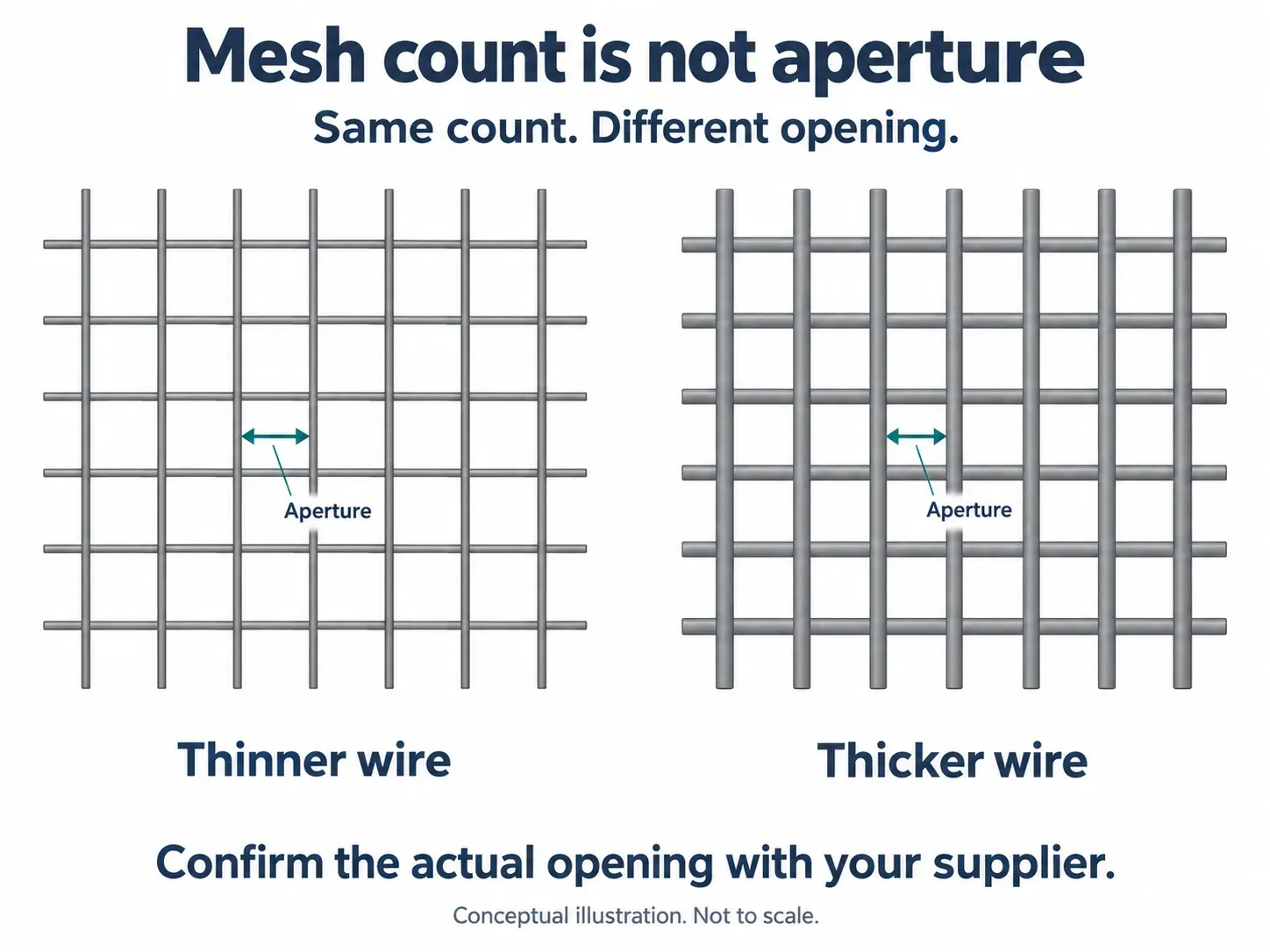
Ask for aperture in millimetres or micrometres
A micrometre, written as µm, is one-thousandth of a millimetre. State the required opening in one of these units when the protected equipment specifies a particle limit. If a drawing gives only mesh, ask whether the intended wire diameter and opening are also controlled.
The screen discussion in the Eaton guide explains this distinction. For your order, request the actual aperture and any relevant tolerance in writing. If a particle-retention guarantee is required, state it explicitly and ask how it will be demonstrated.
A finer screen needs an application reason
Ask what problem the finer option is intended to solve. If the downstream equipment gives a screening requirement, use it as the starting point. If it does not, request a recommendation based on the fluid, debris, flow, and permissible pressure loss.
Discuss how the selected screen affects cleaning frequency and replacement needs. A purchasing decision that considers only particle size can overlook the operating effort required to keep the screen in service. Include spare screens in the enquiry when the maintenance plan depends on quick replacement.
For repeat orders, keep the approved screen specification with the part number. A purchase order that says only “same size Y strainer” can lose an earlier mesh or aperture requirement. If the screen is changed after a trial, update the approved specification before the next production batch.
4. Confirm the thread standard and installed dimensions
Specify the full connection requirement, not just “threaded” and a nominal size. Confirm the thread standard, whether the mating parts are male or female, and the intended sealing arrangement. Also check the installed length and maintenance clearance, since matching thread labels do not guarantee that a replacement body will fit the available space.
NPT, BSPT, and BSPP need different identification
NPT means National Pipe Taper. BSPT is the commonly used name for British Standard Pipe Taper, while BSPP refers to British Standard Pipe Parallel. Tapered and parallel connections require the appropriate matching interface and sealing arrangement; “BSP” on its own may not be specific enough for an order.
Swagelok Georgia's pipe-thread guide explains that NPT and BSPT have different thread geometry and should not be intermixed. It also distinguishes tapered thread sealing from the designed gasket or O-ring arrangements normally used with parallel BSPP connections.
Do not use the fact that two components start to screw together as proof of compatibility. Put the exact standard in the enquiry and ask the supplier to confirm the mating connection. If a product uses PT or PF designations, retain that designation and request confirmation of the applicable standard before substituting another label.
Request the drawing for the exact configuration
Check the overall length, connection dimensions, body envelope, cap position, and screen-removal space. Include the location of nearby supports, panels, insulation, or equipment that could restrict access. A drawing review should reflect the installed arrangement, including room for the maintenance tools that will be used.
For a replacement, send the existing model and photographs with measurements. Photographs can help identify layout and access constraints, but a thread gauge or controlled drawing is a better basis for confirming the thread itself. Ask the supplier to resolve uncertainty before the order is released.
Equipment builders should keep the approved drawing revision with the bill of materials. If a thread or screen option changes, ask whether the part number, drawing, or inspection requirements also change. This gives purchasing and assembly teams the same description of the part they expect to receive.
5. Check pressure and temperature together
Ask for the allowable pressure at the actual operating temperature and for the exact materials and seals being quoted. Separate maximum pressure and temperature figures do not establish that both limits can be used simultaneously. Include relevant design conditions and transients so the supplier can identify the applicable operating envelope.
A cold rating is not a hot-service approval
WOG stands for water, oil, and gas and is used on the SZ product page as a cold pressure rating. That label does not establish a steam rating or compatibility with every fluid described by those categories. Hot service needs a pressure-and-temperature review for the selected construction.
Manufacturer manuals illustrate why those limits must be considered together. For example, Spirax Sarco's strainer installation and maintenance manual provides operating envelopes for its listed models. Those curves support the selection principle; their numerical limits must not be transferred to another manufacturer's product.
In the purchase specification, distinguish normal operation from the design case. Record any cleaning cycle, thermal cycle, or start-up condition that needs review. If the supplier's quotation simply repeats catalogue maxima, ask it to confirm the intended duty rather than assuming the review has already been completed.
The screen has its own differential-pressure limit
The body pressure rating and the screen's allowable differential pressure are different limits. Differential pressure means the pressure difference across the screen. Ask the supplier for the recommended cleaning criterion and the maximum permissible differential pressure for the selected screen construction.
Keckley's Y-strainer maintenance manual explains how blockage can expose a screen to damaging differential pressure. Its maintenance thresholds are specific to its products, so the useful procurement step is to obtain the correct limit for the actual unit being ordered.
Do not write a universal cleaning setpoint into the purchase order from an unrelated manual. If the project needs differential-pressure monitoring, ask the system designer to specify the measurement arrangement and the action to take at the approved limit.
6. Plan installation, cleaning, and replacement access
Confirm the mounting orientation and maintenance procedure for the selected model before finalizing the piping layout. Check the flow-direction marking and leave space to withdraw the screen. Opening a cap or plug requires the equipment to be safely isolated, depressurized, drained as necessary, and cooled in accordance with the manufacturer's instructions and site procedure.
Orientation depends on the service
For general guidance, Spirax Sarco's strainer installation overview shows the pocket downward on horizontal liquid lines and sideways on horizontal steam or gas lines to avoid collecting liquid. It discusses vertical installation with downward flow. Apply the chosen model's instructions; these arrangements do not establish that every strainer is suitable for every listed service.
Show the intended orientation on the installation sketch sent with the enquiry. If the available layout differs from the supplier's recommended arrangement, resolve the layout before purchasing. Rotating a unit to fit a crowded space should not silently change the approved installation.
A plug is not a drain valve
A plugged opening and an installed drain-valve assembly are different configurations. Do not treat a threaded plug as a valve to be loosened on a live pressurized line. If the maintenance plan requires controlled discharge, specify an appropriate drain arrangement and have the supplier confirm its suitability and operating procedure.
Record how discharged fluid will be contained and how the operator will confirm isolation and pressure relief. Do not rely only on a zero gauge reading as proof that trapped pressure has been eliminated. Maintenance procedures belong with the installed equipment, not just in the purchasing email.
For the order itself, ask for replacement-screen identification, seal requirements, and screen-removal clearance. If the strainer will be installed behind a panel, request an access check before the layout is frozen. These questions are easier to resolve from a drawing than from a completed skid.
What is available in the SZ Valves threaded Y-strainer range?
Use the published YS configuration as the starting point for an enquiry, then confirm the order-specific details in the quotation. The product page distinguishes standard options from made-to-order options. It does not provide all the hydraulic, screen-opening, or hot-service data that an individual application may require.
| Item | Published information |
|---|---|
| Body | CF8M, cast 316, as standard; CF8, cast 304, made to order |
| Nominal size range | 1/4 inch to 3 inches |
| Female threads | PT from stock; NPT or PF made to order |
| Screen options | 316 stainless; 20, 60, or 100 mesh; 20 mesh is the published default |
| Published limits | 800 WOG cold rating; listed temperature range −20°C to 180°C. Confirm allowable pressure at the required temperature. |
| Drain provision | Standard blow-off plug; any required drain-valve arrangement must be specified separately |
Refer to the threaded Y-strainer product page for the current listing. For a different mesh requirement, material request, or marking, send the requirement through the OEM and custom manufacturing enquiry. Request confirmation rather than assuming a listed customization is available in every combination.
Ask for the actual screen opening, configuration-specific flow data, applicable differential-pressure limit, and any necessary pressure-temperature confirmation. Keeping these application requirements separate from the catalogue description makes it easier to identify what the quotation has established and what is still open.
How do you compare quotations without losing the specification?
Compare quotations against the same approved requirements, including the screen and connection details. A lower price is only directly comparable when the supplied scope is understood. Ask each supplier to identify deviations, excluded documents, and assumptions so the purchasing decision reflects the assembly and support being offered.
Put deviations in writing
Separate mandatory requirements from preferences in the enquiry. A connection standard needed to mate with existing pipework is normally a different kind of requirement from a preferred marking location. If a supplier proposes a change, have the responsible reviewer accept it explicitly instead of letting it disappear into a revised description.
For a repeat production order, reference the approved part number, drawing revision, screen specification, and any agreed marking. If the supplier offers an alternative screen or seal, ask what changes and whether a new approval is needed. The purchasing record should explain the delivered configuration without depending on someone remembering an earlier conversation.
Define the documents you actually need
A material report, a dimensional inspection record, a leak-test record, and a regulatory conformity document answer different questions. Name the documents required by the project and ask the supplier to confirm what it can provide. Do not assume a general company certificate establishes the scope of a particular product approval.
For SZ Valves, request the body material report at order time if needed, as described in the ordering and documentation FAQ. Agree on any additional records before ordering. A certificate requested after production may involve information that was not included in the original inspection scope.
Also confirm quantity, delivery target, destination, sample requirements, and spare parts. Treat quoted availability as order-specific. For an equipment program, it may be useful to separate a first-article or sample review from approval for repeat orders, with the acceptance checks written down in advance.
What information should you include in a Y strainer RFQ?
An RFQ, or request for quotation, should give the supplier enough information to price a defined configuration or identify the selection work still required. Include the operating conditions, connections, screening requirement, quantity, and required documents. Attach a drawing or existing part reference when available, and mark unknown values as questions.
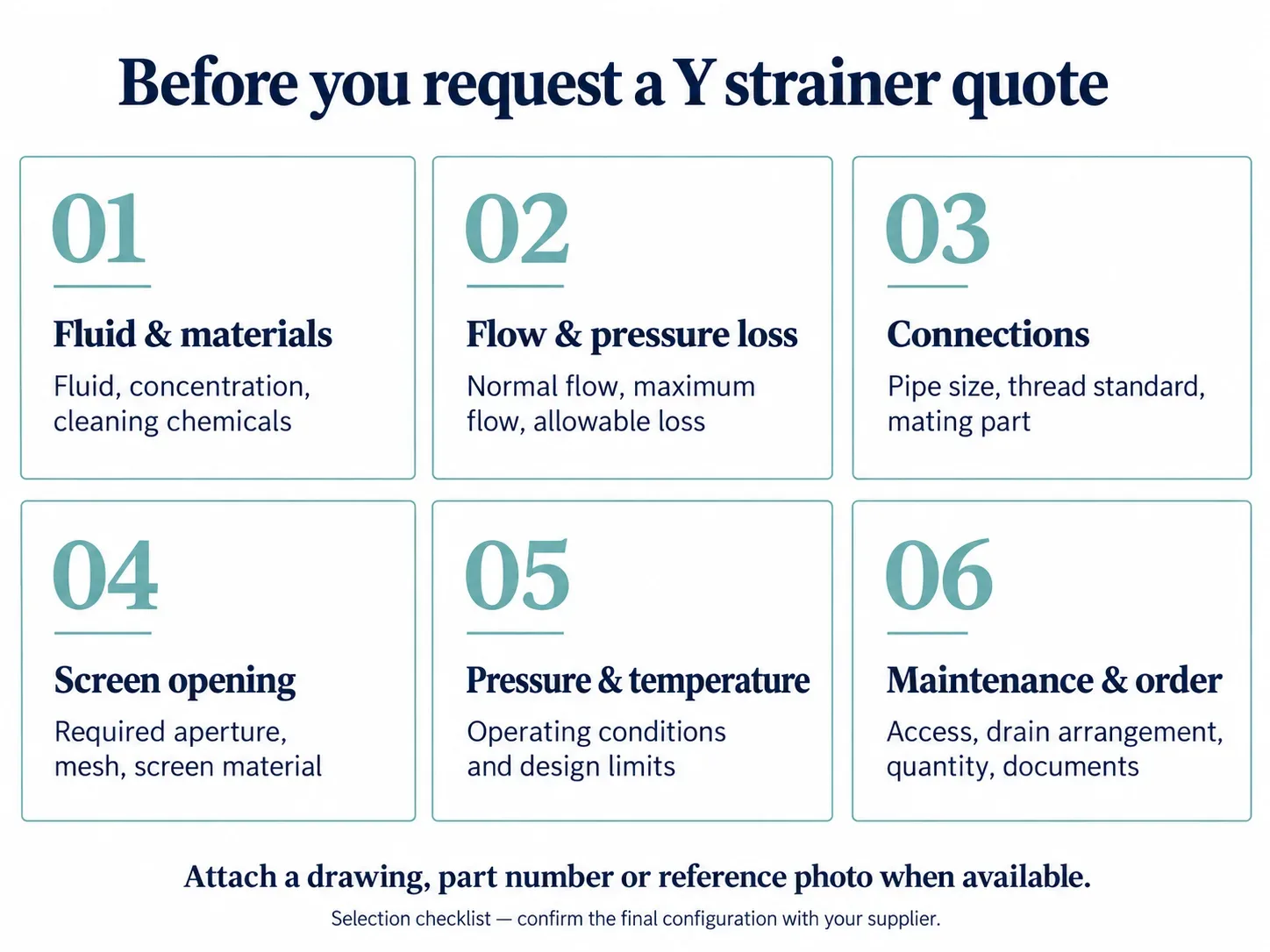
The following checklist can be copied into an enquiry. It is a specification template, not an example of an approved operating duty.
| Field | What to enter |
|---|---|
| Application | New equipment, replacement, or repeat order; identify the downstream equipment |
| Fluid | Name, composition, concentration, and cleaning fluids |
| Flow | Normal and maximum flow, with units and relevant fluid properties |
| Pressure and temperature | Normal and design conditions; relevant start-up, cleaning, or transient conditions |
| Hydraulic requirement | Allowable pressure loss and the conditions at which it applies |
| Connection | Nominal size, exact thread standard, and mating interface |
| Screen requirement | Required aperture or particle limit; mesh and construction if already specified |
| Materials | Body, screen, and seal requirements, or a request for compatibility review |
| Installation and maintenance | Orientation, access constraints, required drain arrangement, and spare parts |
| Commercial and quality scope | Quantity, destination, delivery target, documents, marking, and sample needs |
| Attachments | Drawing and revision, existing part number, equipment requirement, or photographs |
Before approving the quotation, check that the supplier has answered the open questions or clearly identified the remaining engineering review. Keep the agreed configuration with the purchase order. This is especially useful when an initial enquiry is handled by engineering and the eventual order is placed by a different purchasing team.
Frequently asked questions about ordering Y strainers
These questions cover common decisions that arise between identifying a Y strainer and approving an order. The answers distinguish general selection principles from details that need confirmation for the supplied model. Use them to prepare an enquiry, then refer to the quotation, approved drawing, and operating instructions for the final configuration.
How do I choose between 20, 60, and 100 mesh?
Start with the maximum particle size permitted by the equipment downstream, then ask the supplier for a screen opening that meets that requirement. Mesh count alone does not define the opening, because wire diameter and screen construction also matter. SZ Valves lists 20, 60, and 100 mesh for its YS series, but these options are not universal recommendations for every application. Confirm the actual aperture, flow performance, cleaning needs, and replacement-screen specification before choosing the finer option.
Can I connect an NPT Y strainer to BSP pipework?
Do not assume a direct connection is compatible. NPT and BSP thread forms differ, and BSP itself can refer to tapered or parallel arrangements. A nominal size match does not establish a correctly sealed joint. Specify the exact thread standard on both mating components and ask the supplier to confirm the connection. If an adapter is proposed, include its materials, pressure-temperature limits, and sealing arrangement in the system review rather than forcing mismatched threads together.
Does an 800 WOG rating mean the strainer can be used for steam?
No. The SZ Valves product page identifies 800 WOG as a cold pressure rating, not a steam rating. A listed temperature range does not independently establish the pressure permitted at its upper limit. For steam or other hot service, provide the pressure and temperature together and obtain confirmation for the selected body, screen, seals, and installation arrangement. Do not combine catalogue maxima or use another manufacturer's pressure-temperature chart to approve the SZ Valves unit.
Can a Y strainer be installed vertically?
Some Y strainers can be installed in a vertical line with downward flow, but the selected model's instructions must confirm the arrangement. General guidance should not be treated as approval for upward flow or every fluid service. Show the intended flow direction and pocket orientation on the installation sketch, and check access to the cap and screen. If the layout prevents the recommended orientation or safe maintenance, resolve that issue before ordering the unit.
What should I send a supplier to get a useful quotation?
Send the fluid description, normal and maximum flow, operating and design pressure and temperature, pipe size, exact thread standard, screening requirement, and quantity. Add the allowable pressure loss, installation constraints, required documents, and delivery destination. An existing part number, drawing, or photograph helps with replacement enquiries. If you do not know the required mesh or material, say so and request a recommendation with its assumptions stated. The quotation should identify the proposed configuration and any unresolved selection questions.
Before you place the order
A stainless steel Y strainer order is ready when the operating duty, screen, connections, materials, maintenance arrangement, and supplied documentation agree with the quotation. Resolve the missing application data before approving the configuration. Keep those decisions with the purchase record so the first shipment and any repeat orders can be checked against the same requirements.
To request a quotation from SZ Valves, send your operating conditions and Y strainer requirements. Include the size, thread standard, screen requirement, quantity, and a drawing or existing part reference if available. Identify any specification you need help confirming so it can be addressed in the quotation.