

SZ Valves is a check valve manufacturer in Taichung, Taiwan. We cast three stainless steel check valves in our own foundry: the SC threaded swing check valve from 1/2″ to 3″, the 1PC spring check valve from 1/2″ to 2″, and the C series flanged swing check valve from 2″ to 4″. Every valve is leak tested before it ships.
If you are still deciding whether a line needs a check valve or a ball valve, our check valve vs ball valve guide covers that choice.
Key takeaways
- The SC is cast CF8M and rated 200 PSI (WOG), a water, oil and gas rating, with tapered PT (Rc) threads. The 1PC is cast CF8 or CF8M, with PT threads as standard and NPT or PF made to order. The C series is cast CF8 or CF8M with ASME Class 150 or JIS 10K flanges, JIS being the Japanese Industrial Standards.
- Every valve is leak tested and checked for dimensions before it leaves the factory. The SC is also tested to API 598.
- On the flanged valve, Class 150 and JIS 10K versions share a face-to-face length but not the same flange, and on the 3″ and 4″ sizes the bolt patterns do not match, so the flange standard has to be on the order.
- To quote, we need the type, size, quantity, body material, end connection and line conditions.
What a check valve does, and how ours close
A check valve, also called a non-return valve, lets flow pass one way and closes against reverse flow without anyone operating it. Our SC and C series close with a hinged disc, using the weight of the disc and back pressure. The 1PC closes with a spring-loaded piston.
The U.S. Department of Energy's Fundamentals Handbook on mechanical science (DOE-HDBK-1018/2-93) describes check valves as designed "to prevent the reversal of flow in a piping system," and lists how they close: by the weight of the check mechanism, by back pressure, by a spring, or by a combination of these. On many pumped lines they sit at the pump discharge. The DOE and Hydraulic Institute pump system guide notes they are used there to prevent flow reversal when the pump is stopped.
Our three check valve types at a glance
The table compares the three check valves we make, using the specifications on their engineering drawings. Each product page has a drawing to download.
| Valve | Models | How it closes | Sizes | Body material | End connection |
|---|---|---|---|---|---|
| Threaded swing check valve | SC | Hinged disc: disc weight and back pressure | 1/2″ to 3″, 8 sizes | Cast CF8M (316) | PT (Rc) female thread as standard; NPT made to order |
| Stainless steel spring check valve | 1PC | Spring-loaded piston | 1/2″ to 2″, 6 sizes | Cast CF8 (304) or CF8M (316); SS304 or SS316 spring | PT as standard; NPT or PF made to order |
| Flanged swing check valve | C-2F, C-3F, C-4F | Disc on a hinged arm: disc weight and back pressure | 2″, 3″, 4″ | Cast CF8 (304) or CF8M (316) | ASME B16.5 Class 150 or JIS B2220 10K flanges |
The SC: threaded, CF8M, 200 PSI (WOG), 1/2″ to 3″
The SC is our threaded swing check valve, made in eight sizes from 1/2″ to 3″. Its body, cap and disc are cast CF8M, the cast form of 316 stainless steel (ASTM A351 grade CF8M). It is rated 200 PSI (WOG) and tested to API 598, the API standard that sets how valves are inspected and pressure tested. API 598 is a test standard, not a design standard or a certification.
A hinged disc swings off its seat when flow follows the arrow cast on the body, and drops back when flow stops or reverses. There is no spring and no actuator. The gaskets are PTFE, and the plug and bolt are SUS 316, the Japanese designation for 316 stainless steel.
The standard end is a PT (Rc) female thread, a tapered pipe thread. NPT and other thread forms are made to order, so put the thread standard on the inquiry.
The DOE handbook advises against using swing check valves on lines with pulsating flow, where the disc keeps moving against its seat and wears it. Because a swing check closes partly on the weight of its disc, the direction of the line matters too, so put the orientation on the inquiry. Dimensions for every size are on the drawing on the threaded swing check valve page.
The 1PC: spring-loaded, with PT, NPT or PF threads
The 1PC is an inline check valve with a spring-loaded piston, made in six sizes from 1/2″ to 2″. Forward flow lifts the piston off its seat, and the spring pushes it back as forward flow falls.
Body, piston and cap are cast CF8 (304) or CF8M (316), and the spring is SS304 or SS316. Every size is drawn for PT, NPT or PF threads: PT is standard, and NPT and PF are made to order. PT is a tapered pipe thread and PF is a parallel one, so name the thread your pipe ends use.
Sizes, materials and the drawing are on the stainless steel spring check valve page.
The C series: flanged for Class 150 or JIS 10K lines, 2″ to 4″
The C series is our flanged swing check valve in 2″, 3″ and 4″ (DN50, DN80 and DN100, the nominal sizes in millimetres). Body, disc, arm and bolted bonnet are cast CF8 or CF8M, with a PTFE bonnet gasket and stainless steel hardware. Each size is made with ASME B16.5 Class 150 flanges or with JIS B2220 10K flanges, and the valve is rated from −20°C to 180°C.
The face-to-face length is the same for both flange standards: 203 mm on the 2″, 241 mm on the 3″ and 292 mm on the 4″. The flanges are not the same. On the 3″ valve, the Class 150 flange is 190 mm across with four bolt holes on a 152.5 mm bolt circle, while the JIS 10K flange is 185 mm across with eight bolt holes on a 150 mm circle. On the 4″ valve, both have eight bolt holes, on bolt circles of 190.5 mm and 175 mm. The 2″ flanges also differ slightly in diameter and bolt circle. On the 3″ and 4″ sizes, a valve with the wrong flange fits the gap in the line but not the bolts.
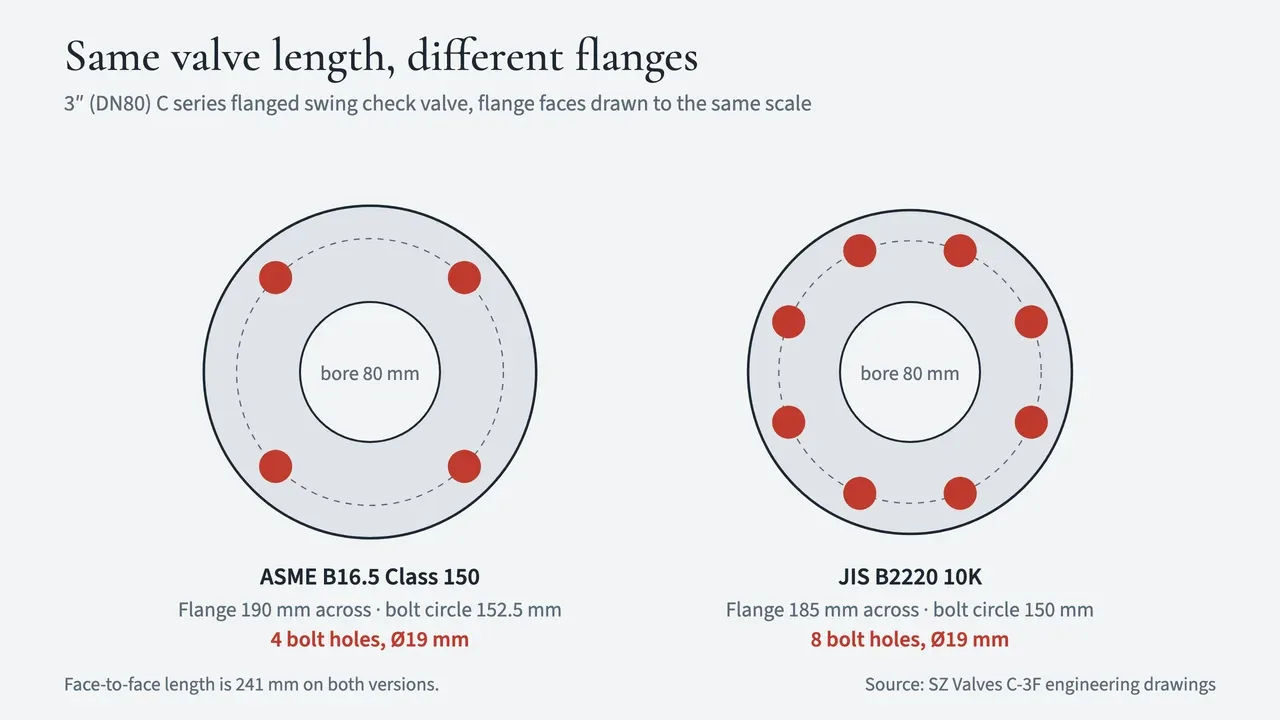
Class 150 and 10K are pressure classes, not pressures in psi. The working pressure a class allows depends on the material and the temperature, which is why ASME B16.34 publishes pressure-temperature ratings by class for Class-rated valves. Specifications for both flange versions are on the flanged swing check valve page.
Check valve manufacturer or trading company? How ours are made
We cast the check valve bodies in our own foundry and machine them on our own floor in Taichung. Every valve is leak tested before it leaves the factory and checked for dimensions, and the SC is also tested to API 598. A mill test report (MTR) for the body material and a dimensional inspection report are available on request.
If you are comparing check valve manufacturers, three questions show quickly who makes the valve and who resells it: where the body is cast, what is tested on every valve rather than on a sample, and which documents can be supplied with the order. Our valve casting guide covers how to tell a foundry from a trader and how to read a material certificate.
What we need to quote your check valves
Send the valve type, size, quantity, body material and end connection, plus the line conditions and any marking or documents you need. With those details we can quote a valve that matches the line.
- Type: SC threaded swing check, 1PC spring check or C series flanged swing check. If you are unsure, describe the line and we will suggest one.
- Size and quantity for each line item. Minimum order quantity is agreed when we quote.
- Body material: CF8 (cast 304) or CF8M (cast 316); the SC is CF8M. Choose CF8M where the line sees chlorides, such as coastal air, seawater spray or de-icing salt. 316 carries about 2 to 3 percent molybdenum, according to a coastal corrosion handbook from the Specialty Steel Industry of North America (SSINA), and molybdenum is one of the elements that help stainless steel resist pitting where chlorides are present.
- End connection: the thread standard for threaded valves (PT, NPT or PF), or the flange standard for the C series (ASME B16.5 Class 150 or JIS B2220 10K).
- Line conditions: the fluid, operating pressure and temperature, and whether the line runs horizontally or vertically and in which flow direction.
- Marking and packing: your part number on the body, private-label marking by laser, stamping or label, and color boxes.
- Documents: a mill test report, a dimensional inspection report, or both.
- Your drawing, if you need a custom version. We can sign an NDA before you send it.
Details that slow down a check valve order
Three details are easy to leave off a check valve inquiry, and each one changes which valve you receive: the flange standard, what a pressure class means, and the thread standard.
- Ordering "a flanged check valve" without the flange standard. Class 150 and JIS 10K valves are the same length, but their flanges differ in every size, and on the 3″ and 4″ the bolt patterns do not match.
- Reading Class 150 as 150 psi. It is a pressure class, and the allowable pressure depends on material and temperature.
- Leaving the thread standard off a threaded valve. A PT valve and an NPT valve are different parts, and the quote should say which one you are buying.
FAQ
Who makes stainless steel check valves?
SZ Valves is a stainless steel check valve manufacturer in Taichung, Taiwan, and has made valves there since 1995. We cast three types in our own foundry: the SC threaded swing check valve in CF8M from 1/2″ to 3″, the 1PC spring check valve in CF8 or CF8M from 1/2″ to 2″, and the C series flanged swing check valve in CF8 or CF8M from 2″ to 4″. Every valve is leak tested and checked for dimensions before it ships.
Can I get your check valves with NPT threads?
Yes. NPT is made to order on both of our threaded check valves. The SC threaded swing check valve has a PT (Rc) female thread as standard, and the 1PC spring check valve is drawn for PT, NPT or PF in every size from 1/2″ to 2″, with PT as standard. PT and NPT are different thread standards, so state the one you need on the inquiry and the purchase order. The C series is flanged, so the choice there is Class 150 or JIS 10K.
Will your flanged check valve fit ANSI Class 150 flanges?
Yes, if you order the Class 150 version. The C series is made with ASME B16.5 Class 150 flanges or with JIS B2220 10K flanges in 2″, 3″ and 4″. Both versions have the same face-to-face length, 203, 241 and 292 mm, but on the 3″ and 4″ sizes the bolt patterns differ: the 3″ Class 150 flange has four bolt holes where the JIS 10K flange has eight. Name the flange standard on the order so the valve bolts up to your line.
Is every check valve tested before shipping?
Yes. Every valve we make is leak tested before it leaves the factory and checked for dimensions. The SC threaded swing check valve is also tested to API 598, the API standard for valve inspection and pressure testing. A mill test report for the body material and a dimensional inspection report are available on request; ask for them on the inquiry so they are prepared with the order.
Can you put our brand or part number on the valves?
Yes. We can mark the valves with your part number on the body and with private-label marking by laser, stamping or label, and we can pack them in color boxes with your branding. If you need a version built to your drawing, send it with the inquiry; we can sign an NDA first. Put the marking and packing details on the inquiry so they are priced with the valves.
Summary
SZ Valves casts three stainless check valves in Taichung, a threaded swing check, an inline spring check and a flanged swing check, and leak tests every one before it ships. To get a quote, send the type, size, quantity, body material, end connection and line conditions. A part number, a spec sheet or a photo is enough to start.