
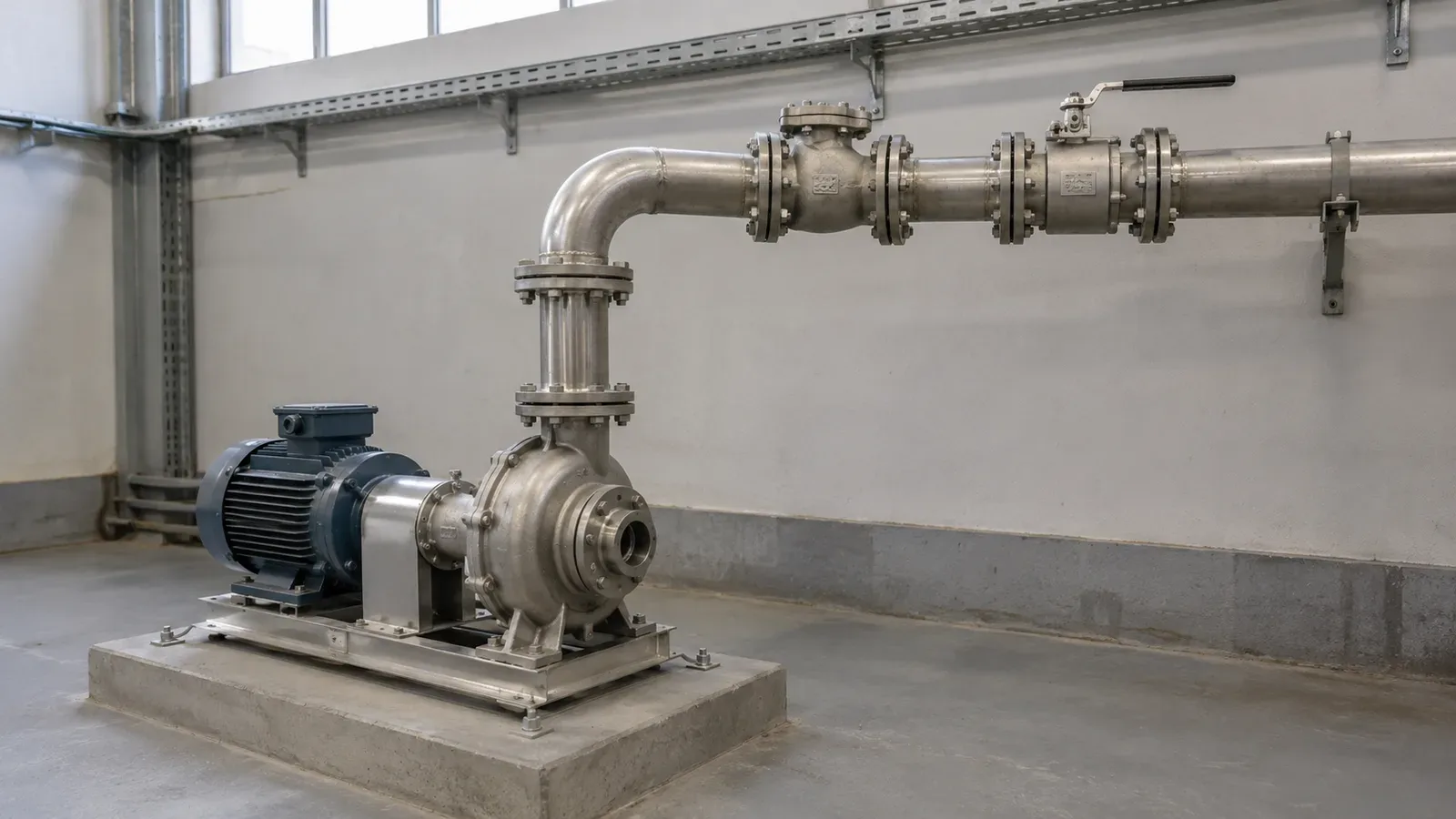
A check valve and a ball valve are not two versions of the same thing. A check valve lets fluid pass one way and closes by itself when flow tries to reverse; nobody operates it. A ball valve is a manual shut-off: a quarter turn of the handle opens or closes the line, and it stays wherever you leave it. On most pump lines you need both, one behind the other, doing two different jobs. This article explains what each one does, where each belongs, and how to pick between the three kinds of check valve we make.
- A check valve protects against backflow automatically. A ball valve gives you a deliberate on-off point.
- A ball valve cannot do the check valve's job, and a check valve cannot do the ball valve's job.
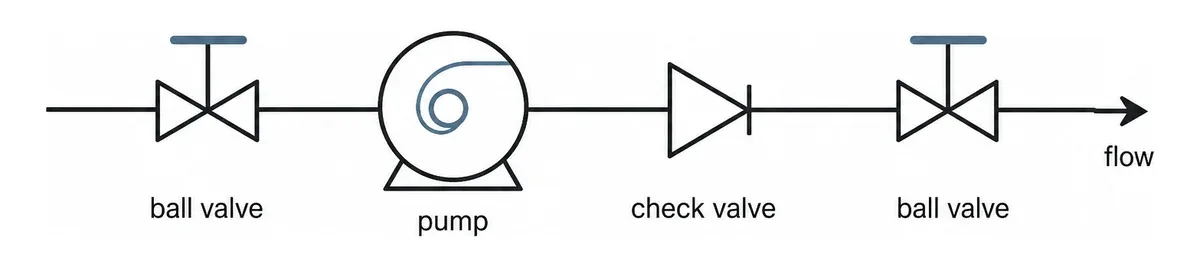
- On a pump discharge, the usual order is pump, then check valve, then ball valve.
- Spring, horizontal swing and flanged swing check valves differ mainly in how they close and which way they can be mounted.
What a check valve does
A check valve, also called a non-return valve, is a self-acting valve that opens when fluid flows in the intended direction and closes when flow stops or tries to reverse. There is no handle and no actuator. The closing element, a disc or a piston, moves because of the fluid itself, so the valve works whether or not anyone is watching the line.
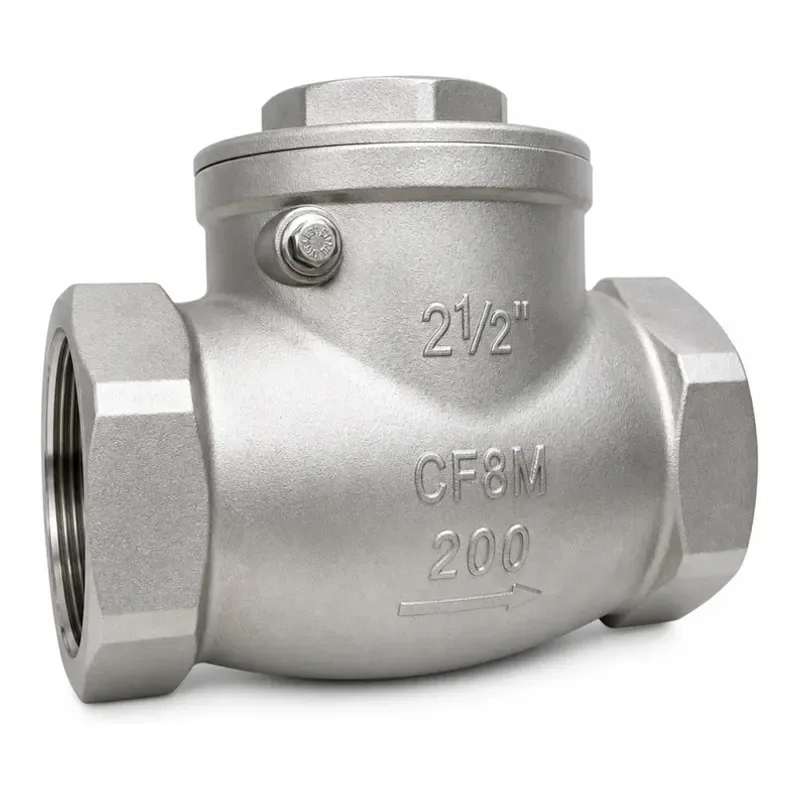
The job it does is protection. When a pump stops, the column of liquid downstream wants to run back through it and spin the impeller in reverse. When two pumps share a header, the running one will push flow backwards through its idle partner unless something stops it. When a line rises vertically, whatever is above wants to drain down. In each case a check valve close to the source closes before the reverse flow gets going. We wrote about the pump-changeover case in more detail in our article on valves in coolant distribution units, where redundant pumps make the check valve a standard fitting.
One naming trap is worth clearing up first. A ball check valve is a check valve whose closing element is a loose ball that seats against the flow when it reverses; despite the name, it is not a ball valve and has no handle. Ours use a spring-loaded piston or a hinged disc rather than a ball.
Check valves differ in how the closing element moves. In a swing check, a disc on a hinge swings open with flow and drops shut under gravity, which is why orientation matters: the valve needs to be mounted so that gravity helps it close. In a spring check, a piston is pushed shut by a spring, so it closes the moment flow reverses and does not rely on gravity. We make both, and the choice between them is covered later in this article.
What a ball valve does
A ball valve is a manual isolation valve. A ball with a hole through it sits between two seats; turn the handle a quarter turn and the hole lines up with the pipe, turn it back and the solid side of the ball blocks the bore. It is meant to be fully open or fully closed. It does not close on its own, it does not care which way the fluid is flowing, and it holds its position until someone changes it.
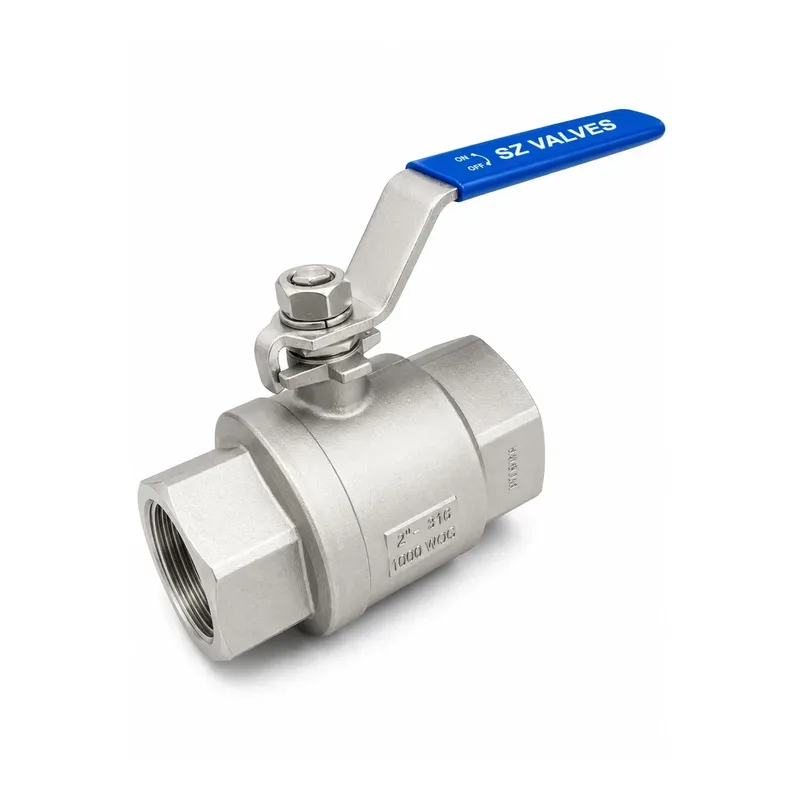
The job it does is control by a person: shutting a branch for maintenance, isolating a pump so a check valve or strainer can be serviced, draining a low point, filling a loop. A full port ball valve, where the hole through the ball matches the pipe bore, adds very little resistance when open, which is why it is the usual choice for isolation on lines where pressure drop matters. What a ball valve is not for is throttling. Left part-open, the flow squeezes past the edge of the ball and wears the soft seat in a pattern that eventually stops the valve sealing when you do close it.
Our two-piece ball valves are cast in CF8 or CF8M with a seal-welded body rather than a threaded or bolted body joint, in sizes from 1/4″ to 4″, rated 1000 WOG with PTFE seats and a full port. The heavier-wall V-2B build is rated from −20°C to 180°C. Why the body joint is welded rather than screwed, and what that removes, is the subject of our article on the heavy-duty 1000 WOG ball valve; the product details are on the two-piece ball valve page.
Check valve vs ball valve: the differences that matter
The table below puts the two side by side. The short version: one is automatic protection, the other is manual control, and the question is almost never which one to buy but where each one goes.
| Check valve | Ball valve | |
|---|---|---|
| Purpose | Prevent reverse flow | Open or close the line on demand |
| How it operates | Self-acting; the fluid moves the disc or piston | Manual quarter-turn handle, or an actuator |
| Flow direction | One way only; an arrow on the body shows which | Either direction |
| Mounting orientation | Swing type: horizontal, or vertical with upward flow. Spring type: does not rely on gravity; confirm orientation when ordering | Any orientation |
| Can it be left part-open? | Not a setting; it floats with the flow | Not recommended; part-open throttling wears the seats |
| Typical place on a pump line | Immediately downstream of the pump | Downstream of the check valve, and on the suction side, for isolation |
| What goes wrong if you use the wrong one | A ball valve in its place gives no backflow protection when nobody is there to close it | A check valve in its place cannot be opened or shut for service |
When you need a check valve, a ball valve, or both
You need a check valve wherever flow must never reverse, and a ball valve wherever a person will need to shut the line. On a pump discharge that means both. The check valve goes as close to the pump as practical so that the column of liquid has the shortest possible distance to travel before it meets a closed disc. The ball valve goes downstream of it, so the check valve, the pump and any strainer can be isolated for service without draining the system. A second ball valve on the suction side completes the isolation.
Some cases lean one way or the other:
- Redundant pumps on a common header. A check valve on each discharge is what stops the running pump from short-circuiting flow backwards through the idle one. The isolation ball valves let you swap a pump while the other keeps running.
- Vertical risers and booster or well pump systems. A spring check valve, because the spring closes the piston without help from gravity; confirm the orientation and flow direction with us when ordering.
- Lines sensitive to water hammer. A spring check, because fast spring closing checks reverse flow before the pressure surge builds. A swing check closes more slowly.
- Horizontal runs where you prefer no spring in the flow path. A horizontal swing check, mounted with the cap uppermost so the disc falls shut on its own.
- Larger flanged lines and waterworks. A flanged swing check, which unbolts from the line for service and has a bolted bonnet so the disc can be inspected without cutting pipe.
- A drain, a fill point, a branch to a gauge. A ball valve alone. Nothing here needs automatic backflow protection; it needs a person to be able to open and close it.
Choosing between spring, horizontal swing and flanged swing check valves
We make three stainless check valves, and the differences between them are practical rather than subtle: how the valve closes, which way it can be mounted, what size range it covers, and how it connects to the pipe. The table is taken from the three product pages; the links go to the full specifications and dimension sheets.
| Spring check valve | Horizontal swing check valve | Flanged swing check valve | |
|---|---|---|---|
| Closing action | Spring-loaded piston; closes the instant flow reverses | Hinged disc closes under gravity and reverse flow | Hinged disc closes under gravity and reverse flow |
| Mounting | Not limited to horizontal runs; confirm orientation when ordering | Horizontal with cap up, or vertical with upward flow | Horizontal with cap up |
| Sizes | 1/2″ to 2″, six sizes | 1/2″ to 3″, eight sizes | 2″, 3″ and 4″ |
| Body material | CF8 or CF8M; spring in SS304 or SS316 | CF8M | CF8 or CF8M |
| End connection | PT, NPT or PF threads | PT female threads; NPT and others made to order | Flanged, ASME B16.5 Class 150 or JIS B2220 10K |
| Pressure rating | See product page | 200 PSI WOG | By flange class |
| Testing | Every unit leak tested before shipment | Every unit leak tested before shipment; tested to API 598 | Every unit leak tested before shipment |
| Fits where | Tight inline spaces, risers, pump discharge and priming | Horizontal pump discharge, chloride-bearing lines | Pump discharge, municipal water and treatment, seawater-adjacent piping |
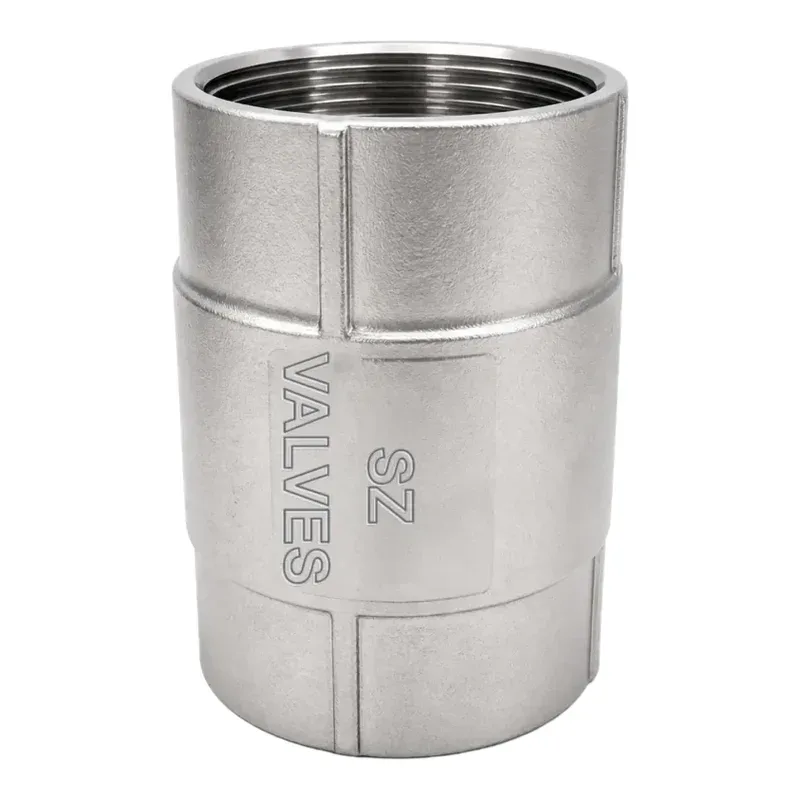
If the run is horizontal and you want the simplest possible mechanism, the swing check has nothing to adjust and no spring to tire. If the run is vertical, space is tight, or water hammer is a concern, the spring check answers all three at once. The flanged swing check is the choice when the line is already flanged and you want to unbolt the valve, or open the bonnet, rather than cut pipe. Whichever you choose, follow the flow arrow cast into the body; a check valve installed backwards is a plug.
Common mistakes with check valves and ball valves
These are the errors that arrive in enquiries and in failure reports. None of them is exotic.
- Using a ball valve where a check valve is needed. A closed ball valve does stop backflow, but only while it is closed. The moment it is opened for normal flow, it offers no protection when the pump trips. Backflow protection has to be automatic.
- Using a check valve where a ball valve is needed. A check valve cannot be shut to isolate a section. If you need to work on the line, you need a valve with a handle.
- Mounting a swing check on a vertical line with downward flow. Gravity then works to hold the disc open instead of shutting it, and the valve will not seat reliably. Use a spring check, or mount the swing check so that flow travels upward.
- Ignoring the arrow. Every check valve has a flow arrow cast into the body. Installed against it, the valve stays closed.
- Throttling with a ball valve. A part-open ball valve wears its seats. If you need to regulate flow, that is a different valve; a ball valve is for open or shut.
- Reading WOG as a steam rating. WOG is a cold working pressure on water, oil and gas. It says nothing about hot service or steam.
- Specifying CF8 for a chloride duty on price. The saving is small next to a pitted body. If the fluid carries chlorides, specify CF8M for both the check valve and the ball valve.
Materials and ratings you will see on both valves
The same two grades and the same rating conventions appear on check valves and ball valves alike, so it is worth reading them once. CF8 and CF8M are cast stainless grades defined under ASTM A351. CF8 is the cast form of 304; CF8M is the cast form of 316, and the M stands for the molybdenum it contains. Molybdenum is what improves resistance to pitting in chloride-bearing fluids, which the International Molybdenum Association explains in its note on molybdenum-grade stainless steels. CF8 is the standard choice for water, air and general service; CF8M is the one to specify for seawater-adjacent, brine or chemically aggressive lines.
Pressure ratings come in two forms. A WOG figure, such as the 1000 WOG on our two-piece ball valves or the 200 WOG on the horizontal swing check, is a cold working pressure on water, oil and gas at ambient temperature. A flange class, such as Class 150, is a pressure-temperature rating class defined in ASME B16.34, with the flange dimensions themselves set by ASME B16.5; our flanged swing check is drilled to Class 150 or to the Japanese JIS 10K pattern, and the face-to-face length is the same either way. Flanged check valves as a category are covered by API 594. Testing before shipment follows API 598, the valve inspection and testing standard; every valve we ship, check or ball, is leak tested first, the SC swing check is tested to API 598, and a mill test report for the body material is available on request.
FAQ
Can a ball valve be used as a check valve?
No. A ball valve only stops flow while someone has closed it. When it is open for normal service it passes flow in either direction, so it gives no protection when a pump stops and the line tries to run backwards. A check valve closes by itself the instant flow reverses, without anyone present. If you need backflow protection, fit a check valve; if you also need to isolate the line, fit a ball valve downstream of it. The two are not substitutes for each other.
Do I need a check valve if I already have a ball valve?
If the line can flow backwards when the pump stops, yes. The ball valve gives you a way to shut the line by hand; it does nothing automatically. On a pump discharge the usual arrangement is the check valve first, as close to the pump as practical, then the ball valve for isolation. On a simple drain, fill point or gauge branch, where nothing needs automatic protection, a ball valve on its own is enough.
Which check valve works on a vertical pipe?
A spring check valve does not rely on gravity to close, so it is not limited to horizontal runs; confirm the orientation and flow direction when ordering. A swing check valve depends on gravity to drop the disc, so it is built for horizontal runs with the cap uppermost, or for vertical runs only where the flow travels upward. On a vertical line with downward flow a swing check will not seat reliably. In every case, install the valve with the arrow on the body pointing in the direction of flow.
Where does the check valve go relative to the pump and the ball valve?
Immediately downstream of the pump, before the isolation ball valve. Placing the check valve close to the pump gives the liquid column the shortest distance to travel before it meets a closed disc, which limits reverse spin of the impeller and the surge that follows. The ball valve goes after the check valve so that the pump, the check valve and any strainer can be isolated for service. A second ball valve on the suction side completes the isolation set.
Should I choose CF8 or CF8M?
CF8 is cast 304 stainless and is the standard choice for water, air and general service. CF8M is cast 316; the added molybdenum resists chloride pitting, so specify it for seawater-adjacent, brine or chemically aggressive lines. The same logic applies to the check valve and the ball valve on the same line, so choose one grade for both. Both grades are defined under ASTM A351, and the grade on the material certificate should read CF8 or CF8M, not 304 or 316, when the body is a casting.
The short version
A check valve stops reverse flow by itself; a ball valve opens and closes the line when a person decides. On a pump discharge you want both, in that order. Pick a spring check for vertical runs, tight spaces and water-hammer-sensitive lines, a horizontal swing check for horizontal runs where you prefer no spring in the path, and a flanged swing check where the line is flanged and you want to unbolt the valve for service. Choose CF8M over CF8 whenever chlorides are present, and choose the same grade for both valves. If you would like the full specifications, the three check valves and the two-piece ball valve are on the products page; send a part number, a drawing or a description of the line and we will quote it.