
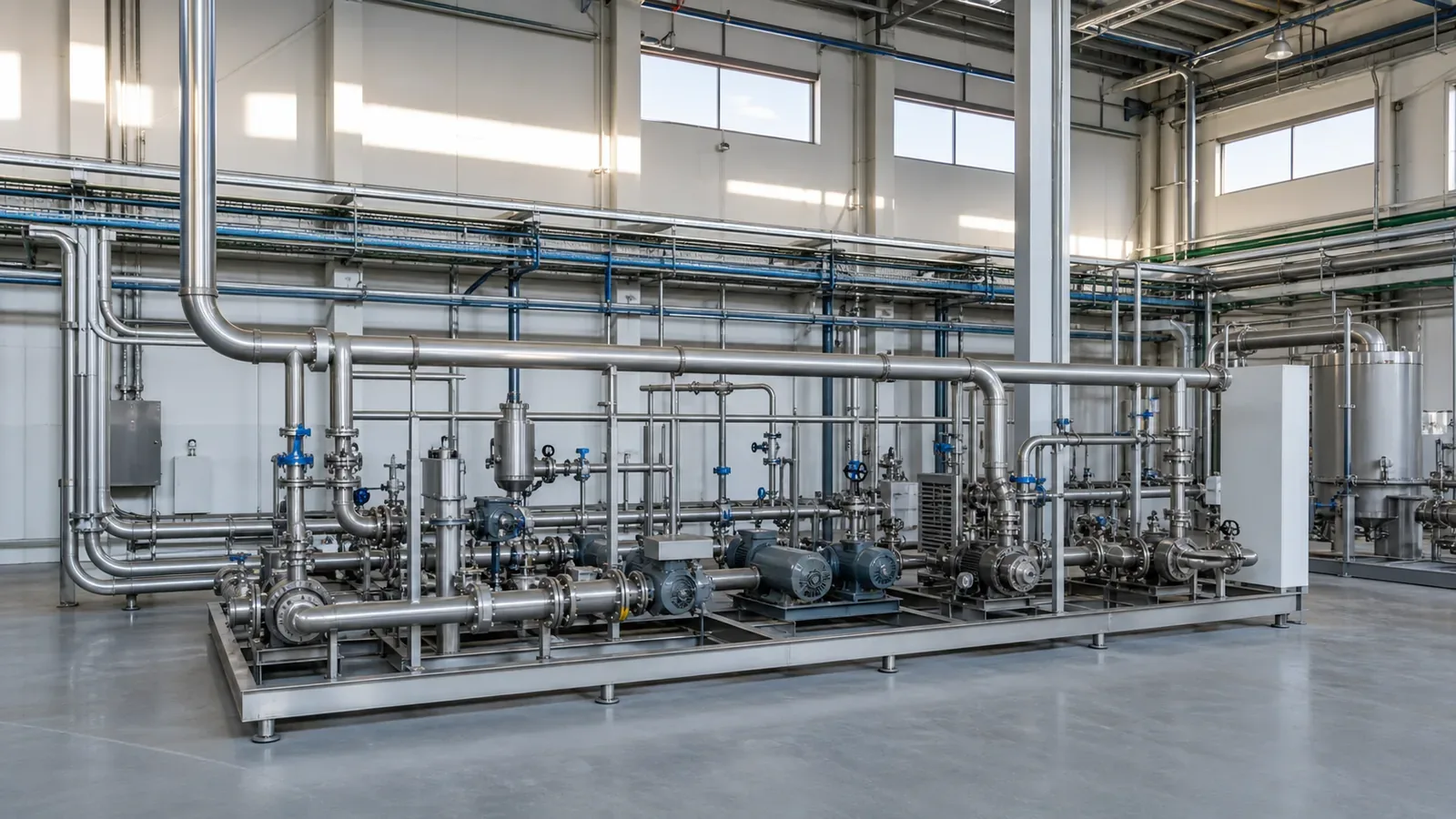
Buyers do not usually ask us for a "heavy-duty ball valve" in those words. They ask for a valve that will not weep at the body joint after two years on a pump skid, will not choke the line it sits in, and will not need a service visit every season. Put into specification language, that request reads: full port, 1000 WOG, stainless body — and, if you want the joint problem gone for good, a seal-welded two-piece body. This article walks through what each of those terms actually means, where ball valves really start to leak, and why welding the body joint shut changes the arithmetic.
What "heavy-duty" actually means on a ball valve
Heavy-duty is not a rating. No standard defines it, so any catalogue can print it. When the term means something, it points at four physical things: a thicker body wall, a full-bore flow path, a pressure rating with margin over the service, and a body construction that does not loosen with time. The rest of this article takes those four apart one by one.
A useful habit when you read any valve catalogue: every time you see a comfort word — heavy-duty, industrial-grade, premium — look for the number or the construction detail behind it. If there is none, the word is decoration. The specifications that carry actual information on a compact stainless ball valve are the pressure rating (WOG), the port, the body material and how the body pieces are held together.
What does 1000 WOG mean?
WOG stands for Water, Oil, Gas. A valve marked 1000 WOG is rated for 1,000 psi of working pressure with those cold, non-shock media. It is a room-temperature rating: as temperature rises, the allowable pressure falls, and WOG says nothing about steam at all.
Two practical readings follow. First, 1000 WOG carries a lot of margin for most process, utility and machine-skid work — a line running at 150 psi is using a seventh of the valve's rating, which is exactly the kind of headroom that makes a valve feel "heavy-duty" in service. Second, the marking is only half the picture: the seat material sets the temperature ceiling. On our valves the seats are PTFE and the published working range is −20 °C to 180 °C, so pressure and temperature must be read together, not separately.
| Marking | What it tells you | What it does not tell you |
|---|---|---|
| 1000 WOG | 1,000 psi max working pressure on cold water, oil or gas | Anything about steam or hot service |
| Seat material (e.g. PTFE) | Temperature range and media compatibility | Pressure capacity by itself |
| Body material (e.g. CF8M) | Corrosion resistance and strength class | The valve's tested tightness |
| Full port | Bore equals pipe bore — no built-in restriction | — |
Full port or standard port: why the bore decides more than you think
A full port ball valve has a bore the same diameter as the pipe it sits in, so an open valve adds almost no restriction to the line. A standard (reduced) port valve necks the flow down about one pipe size, which costs pressure drop and flow capacity in exchange for a smaller, cheaper body. Distributor references such as the ISM comparison of full port and standard port valves and the Merit Brass valve port guide draw the same line.
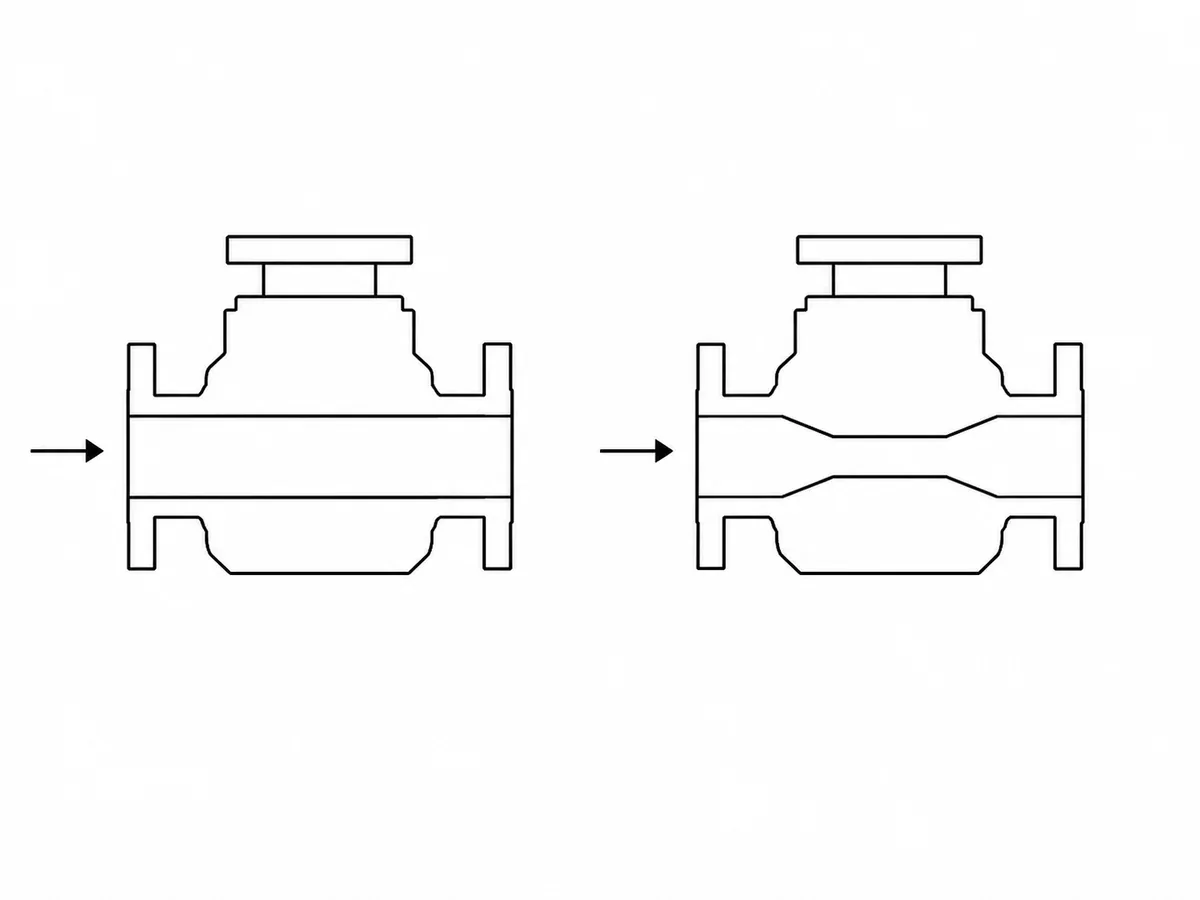
For a heavy-duty specification the choice is usually not close. Pumped loops pay for every psi of unnecessary pressure drop in energy; slurries and dirty media clog reduced bores sooner; and if a line ever needs to be pigged or rodded through, only a full bore allows it. Where standard port earns its place is compact, low-consequence service — gauge isolation, drain points, tight panels — where the restriction simply never matters.
| Full port | Standard (reduced) port | |
|---|---|---|
| Bore vs pipe | Same diameter | Roughly one size smaller |
| Pressure drop | Near zero when open | Noticeable, rises with flow |
| Dirty media / slurries | Preferred | Clogs sooner |
| Body size and cost | Larger, costs more | Smaller, cheaper |
| Typical heavy-duty use | Pump discharge, process mains, transfer lines | Gauges, drains, instrument isolation |
Where ball valves actually leak
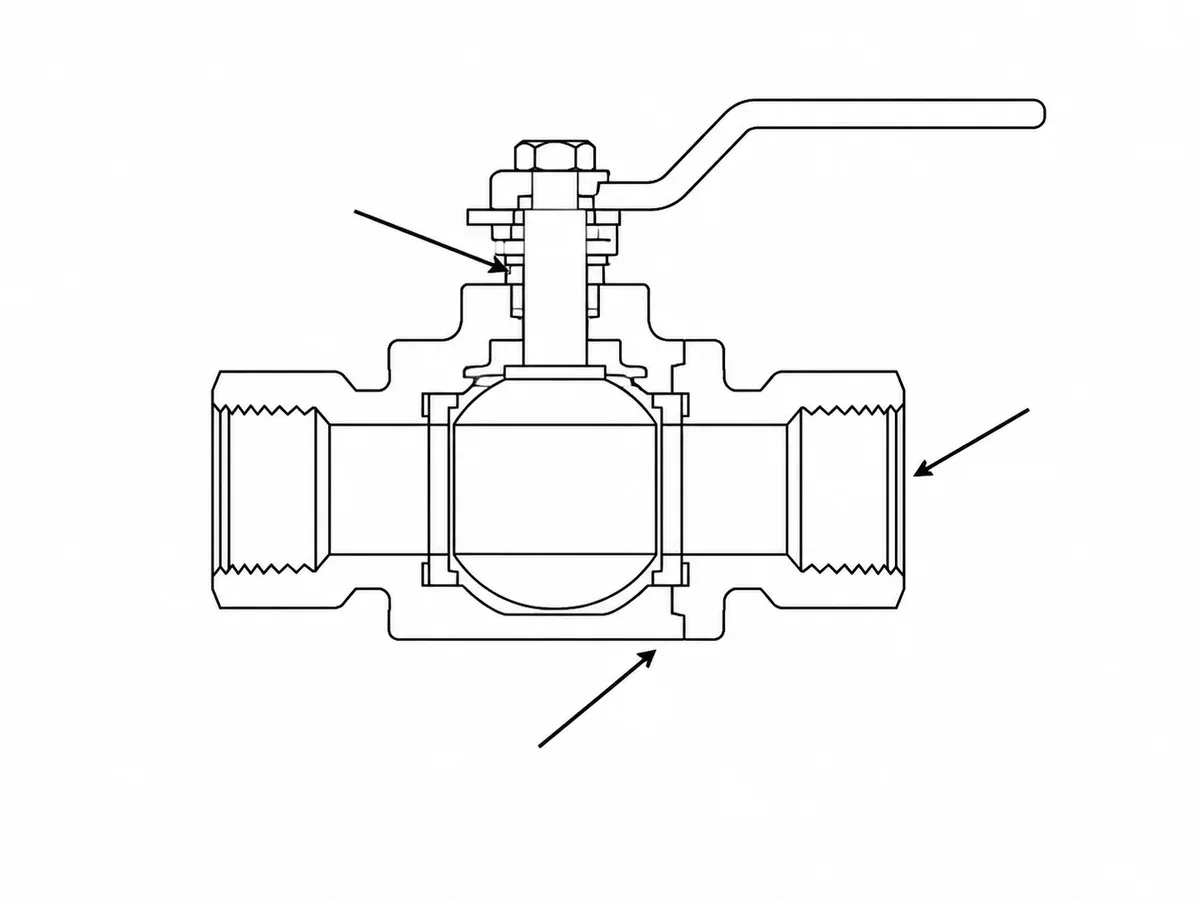
A ball valve has exactly three places it can leak to the outside world: around the stem, past the end connections, and through the body joint. Knowing which one is weeping tells you whether you are looking at maintenance or at replacement.
At the stem or handle
Liquid tracking down from under the handle means the stem packing has relaxed or worn. On many valves a packing nut can be snugged a quarter turn to restore the seal; when the packing itself is done, the fix is service or replacement. Frequent cycling and temperature swings shorten packing life — this is the leak that shows up first on hard-worked valves.
At the end connections
A drip at the threads is an installation issue, not a valve defect: under-taped or cross-started threads, or a union that was never fully seated. The cure is to remake the joint. Reference texts on ball valve construction, such as the Wermac engineering page on ball valves, treat the end joint as part of the piping system rather than the valve — which is exactly how to think about it.
Through the body joint
The third path is the one buyers forget until it finds them. A two-piece valve is exactly what the name says: two body castings holding the ball between them. On most two-piece valves on the market that joint is a large threaded connection. It seals well when new — and then vibration, pipe stress, thermal cycling and the occasional wrench used on the wrong flat all work on it, thread by thread. A body-joint leak cannot be tightened away from outside, and on a threaded-body valve it usually means the valve comes out of the line.
Threaded, bolted or seal-welded: comparing body joints
The short answer: a seal-welded body removes the body-joint leak path instead of managing it. The two castings are joined by a weld, so there is no thread to relax and no gasket to age between body and cap. What was a joint becomes, functionally, one piece of metal.
Each construction is a trade, and it is worth being honest about all three:
| Body joint | How it seals | Strength | Weakness | Where it fits |
|---|---|---|---|---|
| Threaded body | Body threads + sealant or seat compression | Cheap, easy to build | Joint can relax with vibration and thermal cycling; leak means removal | Light duty, stable temperature, low vibration |
| Bolted body (3-piece) | Bolts clamp body and end caps on gaskets | Valve can be serviced in line | More parts, more gaskets, bolts need torque checks | Lines where in-place service matters more than joint count |
| Seal-welded body | Weld — the joint is eliminated | No body-joint leak path, shrugs off vibration | Body cannot be opened; valve is replaced, not rebuilt | Set-and-forget duty: skids, utilities, remote or hard-to-reach runs |
Note the honest limitation in the last row. A welded body is not serviceable through the body — you cannot open it to change seats. For a compact stainless valve this is usually the right trade: the labour to rebuild a small valve costs more than the valve, and what buyers actually want is for the joint never to become a work order. For large or exotic valves where rebuild economics differ, a bolted construction can be the better answer — that is why both exist.
Materials: what CF8 and CF8M buy you
CF8 and CF8M are the cast forms of 304 and 316 stainless steel. CF8 covers water, air and general service; CF8M adds molybdenum, which is what resists pitting from chlorides — the failure mode that finds valves near coastlines, in brine systems and around many process chemicals. On a heavy-duty specification the body material question is really a media question: if chlorides are anywhere in the picture, specify CF8M and stop worrying about it.
Material also decides how the valve ages next to its pipework. A stainless body on stainless pipe keeps galvanic effects out of the picture, and PTFE seats keep the sealing surfaces compatible with most chemistries in the WOG envelope. None of this is exotic — it is simply the combination that keeps a valve boring for years, which is the whole point of a heavy-duty build.
How to specify a heavy-duty ball valve, line by line
Direct answer first: for a compact stainless valve that has to survive real duty, the specification that covers the failure modes is — full port, 1000 WOG, CF8 or CF8M body, PTFE seats, and a seal-welded two-piece body. Then match thread standard (NPT, PT or PF) to your piping, and size the valve to the line, not to the budget.
- Port: full port unless the branch is truly low-consequence.
- Rating: 1000 WOG gives working margin over most utility and process pressures.
- Body material: CF8 for general service; CF8M where chlorides or aggressive media appear.
- Body joint: seal-welded if the valve should never become a maintenance item; bolted 3-piece if in-line rebuild is a hard requirement.
- Threads: NPT for North American systems, PT (Rc) for Taiwan/Asia taper systems, PF for JIS parallel — mixed standards on one skid is a leak generator of its own.
- Evidence: ask the maker how each valve is tested. Every valve we ship is leak-tested before it leaves the plant.
Common mistakes that undo a good valve
The same handful of errors shows up behind most "the valve failed" stories. None of them is exotic and all of them are avoidable at specification or installation time.
- Reading WOG as a steam rating. WOG is a cold rating for water, oil and gas. Steam is a different service with different hardware — if steam is in the picture, say so at the RFQ stage.
- Buying reduced port to save a few dollars on a pumped line. The pump pays for that restriction every hour it runs.
- Wrenching on the body instead of the hex flats. On a threaded-body valve this is how body joints start weeping. (On a welded body there is no joint to disturb — but use the flats anyway.)
- Mixing thread standards. An NPT male will start in a PT female and seal just long enough to pass a quick check, then weep forever. Match the standard, not the feel.
- Ignoring a stem drip. A small packing leak cycles into a big one. Snug the packing early or schedule the swap.
Where the welded-body two-piece earns its keep
Our own two-piece line is built exactly to the specification this article describes, because it is what our OEM customers kept asking for. The V-2B heavy-wall two-piece ball valve runs 1/4″ to 4″, full port, 1000 WOG, in CF8 or CF8M with PTFE seats — and the body is seal-welded rather than threaded or bolted, so the joint between body and cap is not a place the line can start to weep. For the standard-wall build in 1/4″ to 2″, the V-2C stainless steel threaded ball valve shares the same construction logic in a lighter wall.
Both are cast and machined in our own plant in Taichung, Taiwan — the casting side of that story is covered in our guide to how a valve casting manufacturer actually works — and every valve is leak-tested before shipment. If you are specifying valves for an OEM build or a recurring production run, our OEM service page explains how private label, customer part numbers and documentation work with us.
FAQ
What does 1000 WOG mean on a ball valve?
WOG stands for Water, Oil, Gas. A 1000 WOG marking means the valve is rated for 1,000 psi of cold, non-shock working pressure with those media. It is a room-temperature rating: allowable pressure falls as temperature rises, and the seat material — PTFE on our valves — sets the temperature ceiling. WOG says nothing about steam service.
Is a full port ball valve worth it?
On pumped lines, dirty media and anything that may need to be pigged, yes — the full-size bore removes the restriction a standard port builds into the line, so pressure drop stays near zero. Standard port makes sense on low-consequence branches such as gauge isolation and drains, where the smaller, cheaper body costs nothing in practice.
Why is my ball valve leaking at the handle?
A drip from under the handle is stem-packing wear, the most common external leak on a hard-worked ball valve. On many valves the packing nut can be snugged about a quarter turn to restore the seal. If tightening no longer holds, the packing is spent and the valve needs service or replacement. Frequent cycling and temperature swings shorten packing life.
What is a seal-welded ball valve body?
A two-piece ball valve normally joins its two body castings with a large thread. A seal-welded body joins them with a weld instead, so the body becomes functionally one piece: there is no thread to relax under vibration and no body gasket to age. The trade-off is that the body cannot be opened for rebuild — the valve is replaced, not reseated.
Can I use a 1000 WOG ball valve for steam?
Yes — steam service is governed by the temperature rating, not the WOG figure. WOG itself is a cold rating for water, oil and gas, and these valves are rated −20 °C to 180 °C, which covers saturated steam duty. Tell us your steam pressure and temperature when you specify the valve and we will confirm the right build.
My two-piece ball valve is leaking where the two halves screw together. What causes that?
That is a body-joint leak, the third of the three places a ball valve can weep. A two-piece valve is two body castings holding the ball between them, and on most two-piece valves on the market those castings are joined by a large threaded connection. It seals well when new. Vibration, pipe stress and thermal cycling then work on it thread by thread until it starts to pass. You cannot tighten a body joint from the outside, so on a threaded-body valve it normally means the valve comes out of the line. A seal-welded body removes that path instead of managing it: the two castings are joined by a weld, so there is no thread left to relax.
Why is my ball valve leaking from the middle?
The middle is almost always the body joint, the seam between the two body castings. Before you order anything, look at where the liquid starts. If it tracks down from under the handle, the stem packing has relaxed, and a quarter turn on the packing nut often restores it. If it drips at the threads on either end, that is the piping joint rather than the valve, and the cure is to remake it. If it appears at the seam itself, the body joint is passing. That is the one you cannot reach from outside.
Can a leaking ball valve body joint be repaired, or do I replace the valve?
On a threaded-body two-piece valve, replace it. The joint cannot be tightened from outside, and sealant painted onto the outside of a weeping joint does not reach the leak path. A three-piece valve is the exception: it is bolted, so it can be opened in the line and re-gasketed, which is exactly what buyers pay the extra parts count for. A seal-welded body cannot be opened either, but the trade is that it has no body joint to fail in the first place. This is a decision to make before you buy rather than after: if service in place matters most, take the three-piece; if you want the leak path gone, take the welded body.
The short version
Heavy-duty is a result, not a marking. It comes from a full port that does not tax the line, a 1000 WOG rating that leaves margin over the duty, a CF8 or CF8M body matched to the media, and — the part most specifications skip — a body joint that cannot loosen, because it is welded shut. Specify those four lines and the valve disappears into the system, which is the best compliment a valve ever gets. If you want a price on that specification, send a part number, a spec sheet or a photo and we will price it.