
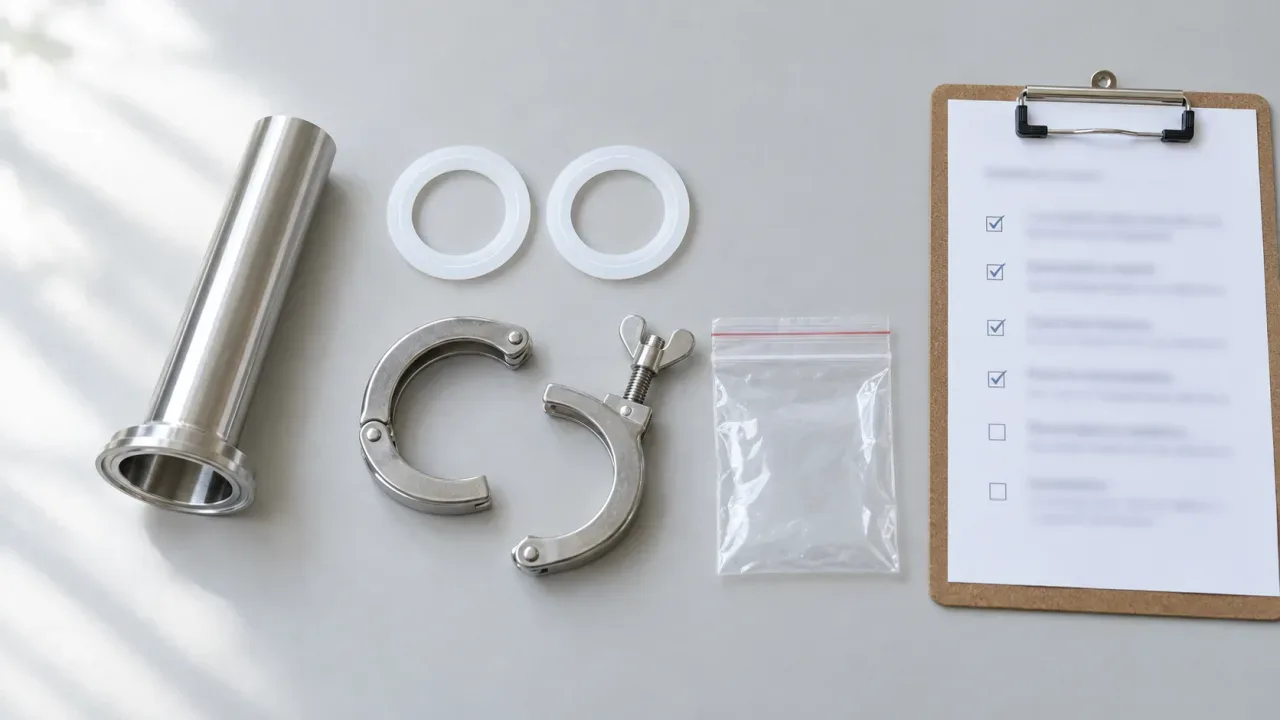
Ask five sanitary valve manufacturers for a price and you will get five quotes with the word "sanitary" on every line. The word tells you the valve is meant for product contact and regular cleaning. It does not tell you which alloy the body was cast in, whether the clamp ends will mate with your tubing, how smooth the bore is, or what paperwork arrives with the goods.
This checklist is for buyers, distributors and process engineers comparing suppliers of sanitary ball valves, three-way valves and butterfly valves for clamp-connected or welded stainless lines. It covers ten things to verify before a first order, what a good answer sounds like, common first-order mistakes, and how to write an RFQ (request for quotation) that produces quotes you can compare. We make sanitary ball valves and butterfly valves in Taiwan, and where our own valves answer a check, we say how we handle it.
What "sanitary" means on a valve quote
A sanitary valve is designed so the surfaces that touch the product can be cleaned and inspected: smooth internal surfaces, no crevices where product can lodge, and ends that open or weld cleanly to stainless tubing. Calling a valve sanitary on a quote does not tell you which standard, if any, it was built to.
Hygienic design has its own reference documents. EHEDG, the European Hygienic Engineering & Design Group, publishes guidelines on hygienic design, including one on requirements for valves in hygienic and aseptic processes (Doc. 14), and ASME sets requirements for bioprocessing equipment in its BPE standard. Without a named standard, two quotes can both read "sanitary ball valve, 316, Tri-Clamp, 1 inch" and describe different parts. One has a cast CF8M body with the bore matched to the tube; the other has a smaller bore that leaves a step at each end. One states the surface finish as a number; the other says "polished". The ten checks below turn the word into things you can measure, read on a document or see on a drawing.
Sanitary valve types you will be quoted
Three types of sanitary valve are covered in this guide: the two-way ball valve for on/off isolation, the three-way ball valve for diverting or mixing between ports, and the butterfly valve for tank outlets and larger lines where a short body and a lower price matter. Choose the type from what the valve position has to do, then compare manufacturers on like-for-like quotes for that type.
| Type | What it does | Where it fits | What to watch |
|---|---|---|---|
| Two-way sanitary ball valve | Opens and closes the line with a quarter turn | Line isolation where a clear, full bore matters | What fills the space around the ball, and whether the body opens on the line |
| Three-way sanitary ball valve | Diverts (L-port) or mixes and distributes (T-port) between three ports | Switching between fillers, tanks or a return loop | The port pattern, and the port a spring-return actuator falls back to on air loss |
| Sanitary butterfly valve | Opens and closes with a disc that turns edge-on to the flow | Tank outlets and on/off duty on larger lines, where a short face-to-face and budget matter | The disc stays in the bore when open, and the valve has two ports only |
Ten checks for sanitary valve manufacturers, at a glance
If you only have ten minutes with a new supplier, ask these ten questions. A manufacturer that makes the valve can answer most of them from its own drawings and records.
| Check | What to ask | A good answer sounds like |
|---|---|---|
| 1. Cast grade | Which grade are the body and ball cast in? | "A351 CF8M body and ball", with the stem and end caps named too |
| 2. End connection | Which clamp standard and tube OD (outside diameter) are the ends made for? | A named standard, or the clamp ferrule OD and tube OD for each size on the drawing |
| 3. Bore | Is it full port, and what is the bore at each size? | A bore dimension you can hold against your tube ID (inside diameter) |
| 4. Surface finish | What is the internal finish, as a number? | A maximum Ra (average roughness) for product contact surfaces, and how it is measured |
| 5. Seats and seals | What are the seats, gaskets, packing and O-rings made of, and over what temperature range? | Named materials and a range that covers the hot end of your cycle |
| 6. Construction | Can the valve be opened without cutting it out of the line? | A body that opens on the line, such as a three-piece ball valve whose centre section unbolts |
| 7. Automation | Is there an ISO 5211 mounting pad (the standard actuator flange), and which flange code? | A pad with a flange code per size, or a plain "manual only" |
| 8. Testing | What test does each valve get, and is it every valve? | Every valve leak tested before shipment, with the method stated |
| 9. Paperwork | Which material document ships with the order? | A named document, such as a mill test report or an EN 10204 3.1 certificate, on the quote |
| 10. Who makes it | Where is the valve cast, machined and assembled? | A plant address, and the people who make the part answering the drawing questions |
1. Cast grade: ask for CF8M by name
Ask for the grade of the body and ball by name. For a cast 316 body the grade is CF8M, one of the grades in ASTM A351, the specification for austenitic steel castings for valves, flanges, fittings and other pressure-containing parts. A quote that only says "SS316" or "stainless" leaves two things open: whether the part is cast or machined from bar, and which grade was actually used.
Grades matter beyond the body. The ball, stem and end caps touch the product too, and a quote should name each of them. CF8 is the cast counterpart of 304. It is a different alloy at a different price, so if your specification allows it, it should appear on the quote as its own line rather than hide behind the word "stainless".
The usual reason to specify 316 over 304 on a sanitary line is chloride. The molybdenum in 316 improves its resistance to pitting where chlorides are present, so 316 is the common choice for brines, salty products and other chloride-bearing service.
How we handle it: on our two-way sanitary ball valves, the manual V-3N and the pneumatic V-3NM, the body and ball are investment-cast A351 CF8M, the end caps are AISI 316, the stem is A276 Gr. 316, and the seats, gaskets and packing are PTFE (polytetrafluoroethylene). The same list is on the product page, so you can hold it against any quote, ours included. Our sanitary butterfly valve is built differently: its body and disc are 304 as standard, with 316 made to order. For what the material certificate behind a cast grade should show, see our guide to checking a valve casting manufacturer.
2. End connections: which clamp standard, which tube OD
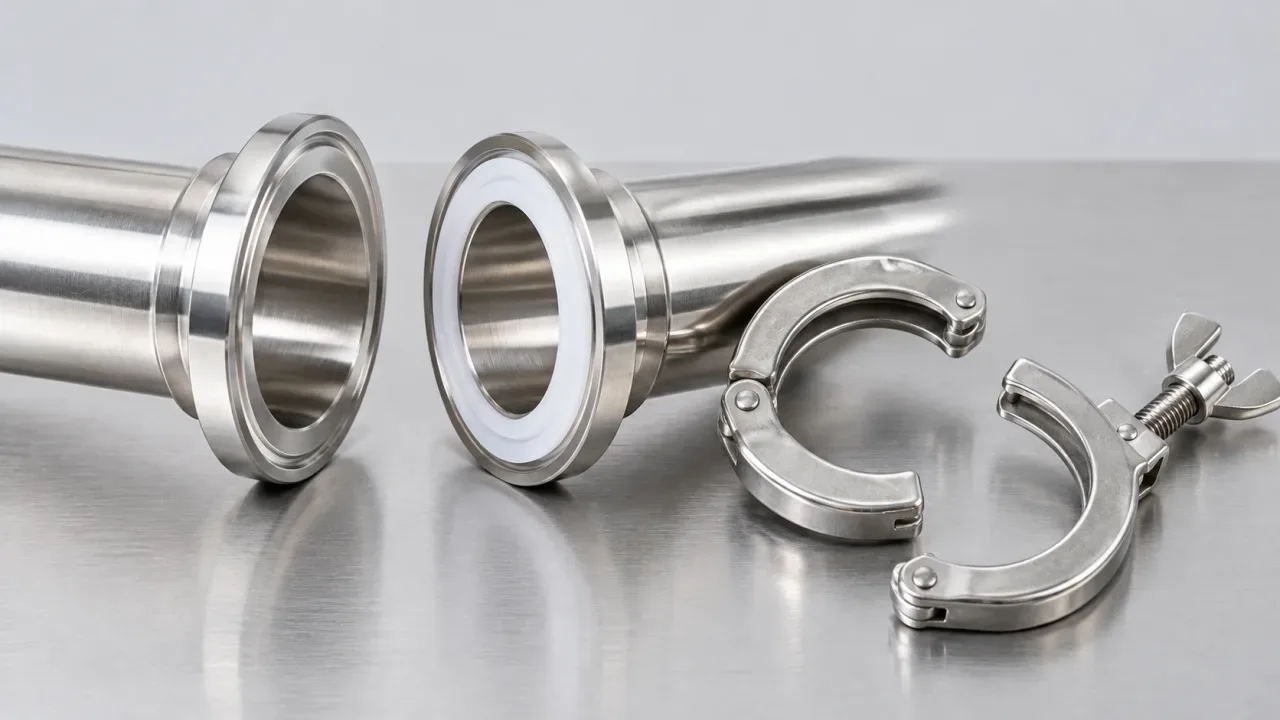
Ask which clamp standard the ferrules follow and which tube outside diameter (OD) the valve is made for. In a clamp joint, often called Tri-Clamp, two ferrules (the flanged ends on the tube and on the valve) are pressed together over a gasket by a hinged clamp. A nominal size such as "1 inch" does not settle either question, so check both on the drawing before you place the order.
Our own dimension sheet shows why the size alone is not enough. On our V-3N, the 1″ and 1-1/2″ valves carry clamp ferrules with the same 50.4 mm OD, and the 1/2″ and 3/4″ share 25 mm. The same clamp closes on either size, so you cannot judge the tube from the clamp. The tube OD is the number that has to match your line.
Weld ends are the other route. An extended butt weld end gives a continuous run with no clamp joint, and the extra length keeps welding heat away from the PTFE seats. Clamp ends suit positions where the valve comes off the line for cleaning or changeover; weld ends suit positions where it stays put.
How we handle it: our V-3N carries Tri-Clamp ferrules and the V-3N-L3 has extended OD-tube ends for butt welding, both in eight sizes from 1/2″ to 4″. The dimension sheets linked from the sanitary ball valve page give the clamp ferrule OD or the tube OD for every size, together with the bore and the face-to-face length.
3. Bore: full port, matched to the tube
A full port valve has a bore that matches the inside diameter (ID) of the tube, so there is no ledge where the valve meets the line for product to build up against. Ask for the bore at each size and compare it with your tube ID. The datasheet may say "full port"; the bore figure on the drawing lets you confirm it.
The check takes a minute. Take the tube OD and wall thickness from your line specification, work out the ID, and set it next to the bore on the manufacturer's drawing. If the bore is clearly smaller, the valve is reduced port at that size, whatever the datasheet calls it, and the step it leaves at each end is one more surface to clean.
Butterfly valves are read differently. The disc turns edge-on to the flow and stays in the bore when the valve is open, so a bore figure says less about a butterfly valve than about a ball valve.
How we handle it: our V-3N and V-3NM are full port in all eight sizes, with the bore matched to the tube inner diameter, and the V-3N dimension sheet gives the bore for each size.
4. Internal surface finish: get it as a number
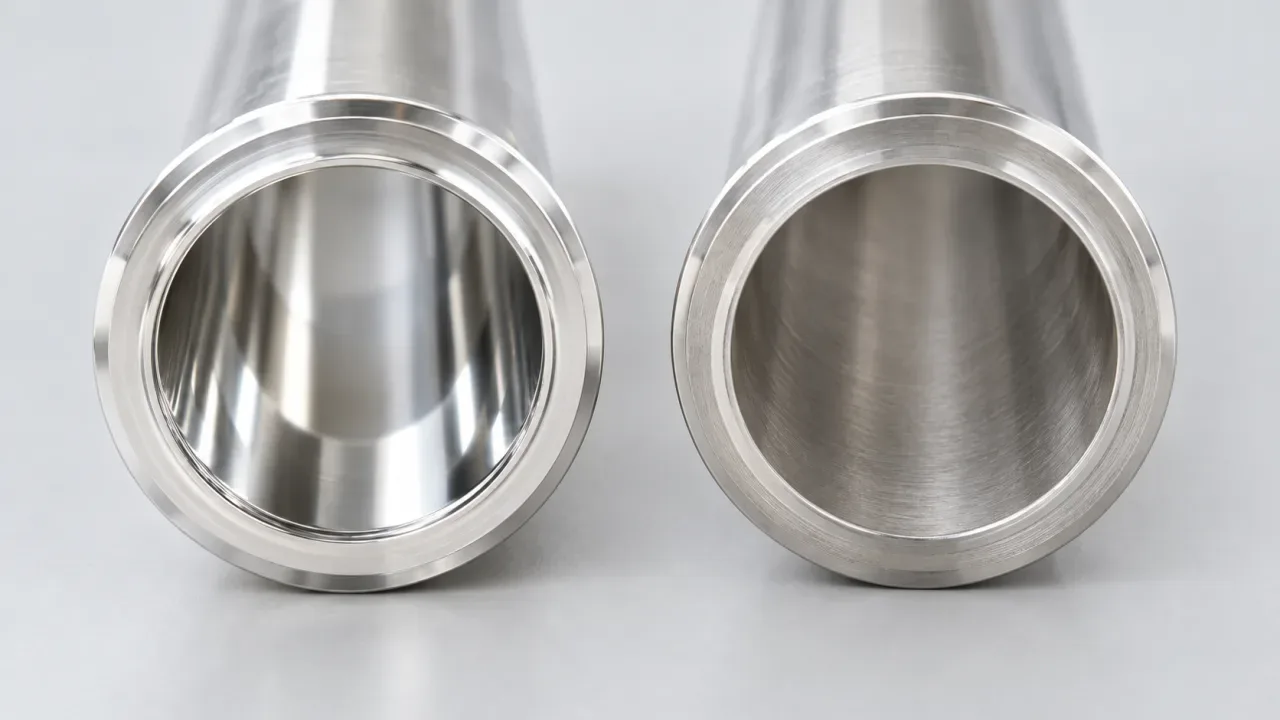
A finish written as a word cannot be inspected. Ask for the finish of the product contact surfaces as a roughness value, usually Ra (average roughness), with a maximum and the units. Ra is the arithmetic mean of how far the surface profile departs from its mean line, so a lower figure means a smoother surface. "Polished" and "sanitary finish" describe a process, and two suppliers can mean quite different results by the same word.
Where the finish matters to your process, write the number into the RFQ, state that it applies to product contact surfaces, and ask how it is measured. If your plant or your customer works to ASME BPE, which has a part on process contact surface finishes, quote the finish requirement from that standard instead of a description. If the specification also calls for electropolishing, list it as a separate requirement: it is an extra process step, and it changes the price.
5. Seats, seals and the temperature window
Ask what the seats, body gaskets, stem packing and any O-rings are made of, and what temperature range the valve is rated for with those parts. On a stainless valve it is usually the soft parts that set the temperature limit. If your line has a hot water rinse or a hot process step, the top of that cycle is the figure to check.
Seat design involves a trade-off, and our own three-way valve shows it. Its encapsulated PTFE seat closes off the dead space around the ball, leaving nothing for product to lodge in, and runs from −20°C to 80°C. The semi-encapsulated seat takes far more heat, −20°C to 180°C, and suits hot water and hot process lines. Which one is right depends on what matters more at that position, and a supplier should be able to explain the choice in those terms.
Pressure needs the same care. A 1000 WOG rating means 1,000 psi of working pressure with water, oil or gas at ambient temperature, so ask what the valve is rated for at your operating temperature as well.
How we handle it: our V-3N and V-3NM have PTFE seats, gaskets and packing, and the valve is rated 1000 WOG and −20°C to 180°C. On our sanitary butterfly valve, the PTFE seat sets the working temperature, so we ask for the line temperature with every enquiry and confirm the seat suits it.
6. Construction: does the valve open on the line?
Three-piece bodies open on the line; one-piece and two-piece bodies generally have to come out of the line before the seats can be reached. In a three-piece ball valve the centre body is held between two end caps by bolts. Remove the bolts and the centre section, with the ball and seats, comes out while both ends stay in the line. Ask any supplier how its valve comes apart for cleaning, inspection and seat replacement.
This matters most where the valve is cleaned by taking it apart. Whether a position can rely on that, or needs a valve designed to be cleaned without opening, is a separate decision, and we cover it in our guide on when a three-piece Tri-Clamp ball valve should be taken apart for cleaning.
How we handle it: our V-3N is three-piece, with a centre body between two AISI 316 caps held by four bolts, and the pneumatic V-3NM uses the same body. The clamp ends open without tools and the body unbolts in place, so the ball, seats and gaskets can be cleaned or replaced between batches. The weld-end versions work the same way: the centre section still comes out after the ends are welded in.
7. Automation: an ISO 5211 pad now, or a new valve later
Ask whether the valve has an ISO 5211 mounting pad, the drilled flange on top of a quarter-turn valve where an actuator bolts on, and which flange code it carries at each size. If a position might be automated later, buy it with a pad now. Some manual sanitary valves have no pad at all, and automating them usually means replacing the valve.
For pneumatic valves, also ask for the air supply range, whether the actuator is double acting (DA) or spring return (SR), which way a spring-return valve moves on air loss, and which accessories are fitted before shipment. A valve that arrives with its actuator, solenoid valve and limit switch box already mounted and tested arrives ready to connect to air and signal.
How we handle it: our pneumatic sanitary ball valve, the V-3NM, has an ISO 5211 high-mount pad that takes the actuator directly, with no bracket to fabricate or align. It ships sized, mounted and cycle-tested, double acting or spring return, on a standard air supply of 4 to 8 bar, with solenoid valves, limit switch boxes and positioners fitted at assembly when they are ordered. Our manual Tri-Clamp three-way valve, the MV-3N, has no actuator pad, so for a diverting position that may be automated later, the pneumatic MV-3M-TC is the one to order. Our guide to the ISO 5211 mounting pad walks through the routes from manual to automated.
8. Testing: what was tested, and how many valves
"Tested" with no detail can mean a leak test on every valve or a check on one piece per lot. Ask what test each valve gets before shipment, whether every valve is tested or a sample from each batch, and which method is used. Get the answer in writing, next to the price.
Two follow-up questions make the answer more useful. Is the test on the seat, meaning leakage past the closed ball, on the body and its joints, or on both? And for actuated valves, is the valve cycled with its actuator before it ships?
How we handle it: every valve we ship is leak tested with water on our test equipment before it leaves the plant, 100 percent rather than a sample from the batch, and our pneumatic sanitary ball valve, the V-3NM, is also cycle-tested after the actuator is mounted.
9. Paperwork: name the document before you order
Ask which document will prove the material, and name it on the purchase order. A mill test report (MTR) records the chemical composition and mechanical properties of the material supplied. Many specifications ask instead for an EN 10204 type 3.1 inspection certificate, issued by the manufacturer and validated by its authorized inspection representative, who is independent of the manufacturing department, with test results from specific inspection of the material delivered.
Certificates held by the company are a separate question. ISO 9001 certifies how a plant manages quality; it is not an approval of a particular valve. Ask which certificates the manufacturer holds, ask to see them, and check whether your specification calls for anything beyond them.
How we handle it: we supply a mill test report for the body material on request; tell us at order time and it ships with the goods. A dimensional inspection report is available the same way. Our plant runs under an ISO 9001 quality management system, and our FAQ lists every certificate we hold.
10. Who actually makes the valve
Ask where the valve is cast, machined and assembled, and who answers when a dimension on the drawing does not match the part. Some companies that quote sanitary valves are trading companies that buy them in. That can work, but it puts another company between your question and the people who can answer it, and it adds time to every drawing query, mismatched part and repeat order.
Four questions sort it out quickly. Where are the bodies cast? Where are they machined? Can you mark our part number on the body? Who do I speak to when a dimension does not match the drawing? A factory can answer all four in one reply. We go through the casting side in more detail in our guide to valve casting manufacturers.
How we handle it: we have made valves in Longjing, Taichung, Taiwan, since 1995. We investment cast the bodies in our own foundry, machine them to final size on our own lathes and assemble them on our own floor, so a question about a drawing goes to the people who make the part. Laser marking and private label are available on our sanitary ball valves.
Common mistakes on first sanitary valve orders
Most of the mistakes below come from one habit: leaving a word on the quote that was never turned into a number or a named document.
- Ordering by nominal size alone. "1 inch Tri-Clamp" without the tube OD and clamp standard leaves room for a valve that clamps on but does not match the tube behind it.
- Accepting "polished" as a finish. Without an Ra value on the purchase order, there is nothing to inspect the delivery against.
- Checking the body and not the seats. The temperature limit sits in the seats, so check them against the hot end of your cleaning cycle.
- Buying a manual valve with no pad for a position that will be automated. The saving on the pad today turns into a replacement valve when the line is automated.
- Asking for "a certificate". If the document type is not named, the paperwork that arrives may not be the paperwork your quality team needs.
- Skipping a sample from a new supplier. One valve on the bench, checked against the drawing, answers most of the questions in this guide before the main order is placed.
How to write an RFQ for sanitary valves
Put the ten checks into the RFQ itself, one line per valve position. When every supplier answers the same fields, the quotes line up for comparison. The table below can be copied as a template.
| Field | What to write | Why it matters |
|---|---|---|
| Valve type and port | Two-way ball, full port; three-way ball, L-port or T-port; or butterfly | Sets the body and the port |
| Size and tube OD | Nominal size, tube OD and wall thickness from your line specification | Removes the nominal-size ambiguity |
| End connection | Clamp ferrule to the standard your line uses, or extended butt weld | Makes sure the ends mate |
| Material grades | Body and ball (or disc) grade by name, such as A351 CF8M for cast 316; stem and end caps named | The grade, not just "stainless" |
| Seats and seals | Seat, gasket, packing and O-ring materials | Temperature and chemical limits |
| Internal finish | Maximum Ra and units for product contact surfaces; electropolishing if required | Something to inspect the delivery against |
| Pressure and temperature | Operating pressure at maximum temperature, and the top of the cleaning cycle | Rating at temperature, not only cold |
| Operation | Lever; lever with ISO 5211 pad for later; or pneumatic DA or SR with fail position and air supply | Automation now or later |
| Accessories | Solenoid valve, limit switch box, positioner | Fitted and tested before shipment |
| Testing | Leak test on every valve, method stated | In writing, next to the price |
| Documents | Mill test report or EN 10204 3.1; dimensional report if needed | The named document ships with the goods |
| Marking and quantity | Part number marking or private label; quantity per size; delivery port and Incoterm | Prices you can compare |
FAQ
What should I ask sanitary valve manufacturers before ordering?
Ask ten things: the cast grade of the body and ball, the clamp standard and tube OD the ends are made for, the bore at each size, the internal surface finish as an Ra value, the seat and seal materials with the temperature range, whether the body opens on the line, whether there is an ISO 5211 actuator pad, what test every valve gets, which material document ships with the order, and where the valve is cast, machined and assembled. Put the answers on the purchase order so the delivery can be checked against them.
Is CF8M the same as 316 stainless steel?
Not exactly. CF8M is the cast counterpart of 316: when a 316 valve body or ball is made as a casting, CF8M is the grade it is poured in, and its composition limits differ slightly from wrought 316. It is covered by ASTM A351, the specification for austenitic steel castings for pressure-containing parts. Like 316, it contains molybdenum for better resistance to chloride pitting. On a quote, a cast body should be listed as A351 CF8M, and a stem machined from bar by its own bar grade, such as A276 316.
What surface finish should a sanitary valve have?
It depends on the product and on the specification your plant works to, so no single figure suits every line. What matters on the order is that the finish is stated as a number: a maximum Ra, in micrometres or microinches, for the product contact surfaces. If you work to ASME BPE, quote its process contact surface finish requirement. If electropolishing is required, list it separately. Then ask the manufacturer how the finish is measured, so the delivery can be checked the same way.
What is the difference between Tri-Clamp and butt weld ends on a sanitary valve?
Tri-Clamp ends join the valve to the line with a ferrule, a gasket and a hinged clamp, so the valve comes off without tools for cleaning, inspection or changeover. Butt weld ends are welded into the tube for a continuous run with no clamp joint, and extended weld ends keep welding heat away from the PTFE seats. On a three-piece body, the centre section still unbolts for service after the ends are welded in, so choosing weld ends does not mean losing access to the seats.
What documents should come with a sanitary valve order?
At minimum, a mill test report for the body material, showing its chemical composition and mechanical properties. Many specifications ask for an EN 10204 type 3.1 inspection certificate instead, issued by the manufacturer and validated by its authorized inspection representative, who is independent of production. A dimensional inspection report is also worth asking for. Name each document on the RFQ and the purchase order rather than asking for "a certificate", so the paperwork is quoted, prepared and shipped with the goods.
Summary
Before a first order with any of the sanitary valve manufacturers on your list, get ten answers in writing: the cast grade, the clamp standard and tube OD, the bore, the finish as a number, the seat materials and temperature window, access to the seats on the line, the actuator pad, the test, the document and the people who make the part. None of them takes long to ask, and every answer belongs on the purchase order.
Our V-3N and V-3NM sanitary ball valves are investment-cast A351 CF8M, three-piece and full port from 1/2″ to 4″, with Tri-Clamp or extended weld ends, PTFE seats and a 1000 WOG rating. The valve is rated −20°C to 180°C, and every valve is leak tested before it ships. If you are lining up a supplier, send the sizes, tube OD, end connection and line temperature through our contact page and we will quote it.