
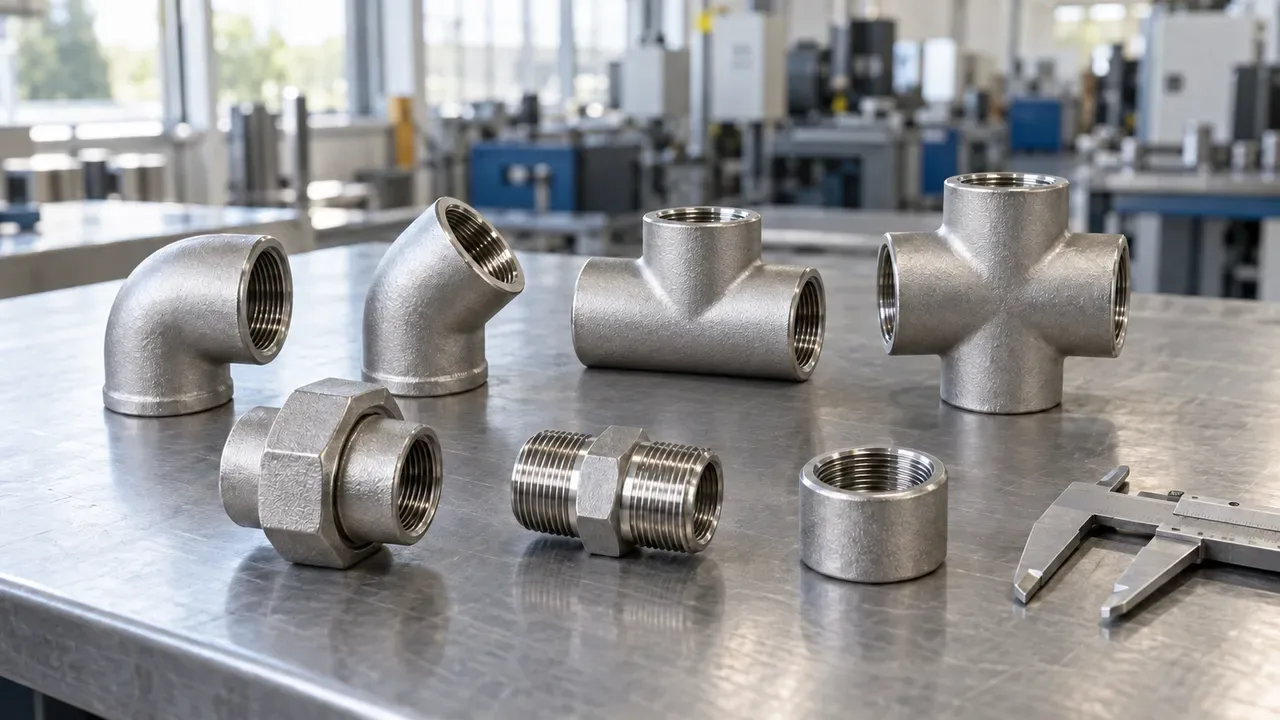
Getting a price from stainless steel pipe fittings manufacturers is the easy part. What decides whether the first order works is what sits behind the price: which grade was quoted, which thread was cut, what the pressure class on the body refers to, how the part was cast and whether anyone tested it before it was boxed.
This checklist is for buyers, distributors and engineers comparing factories for threaded stainless fittings: elbows, tees, crosses, unions, hex nipples, caps and couplings. It covers eight things to verify before a first order, the questions that bring out a straight answer, and the mistakes that cause most first-order problems. We make these fittings ourselves in Taiwan, and where it helps we say how we handle each point.
What a stainless steel pipe fittings manufacturer actually makes
A threaded pipe fitting joins, turns, branches or closes a pipe run, and it seals on the thread itself with tape or sealant. The fittings in this guide are cast: molten metal is poured into a mold shaped like the fitting, then the threads are cut into the casting. The quality of a fitting therefore depends on the alloy, the mold, the thread and the inspection, in roughly that order.
A typical threaded range covers seven shapes, and each one has a job:
- 90 degree elbow and 45 degree elbow to change direction, plus the street elbow, which has one male and one female end so it screws straight into another fitting.
- Tee and cross to branch a line into three or four ways.
- Union to join two pipes so the joint can be opened later without turning the pipe.
- Coupling to join two pipes in a straight line, and hex nipple to join two female ends.
- Cap to close the end of a pipe.
The shapes are standard across the industry. The differences between factories hide in the details that the drawing does not show.
The eight checks at a glance
If you only have ten minutes with a new supplier, ask these eight questions. A factory that makes the parts can answer all of them without checking with anyone else. Hesitation on more than one or two is itself an answer.
| Check | What to ask | A good answer sounds like |
|---|---|---|
| 1. Grade | Which stainless grade is this price for? | A named grade (202, 304 or 316) on the quotation line, not "stainless steel" |
| 2. Thread | Which thread form is standard, and which is made to order? | A thread standard by name, with a clear note that PT and NPT are different |
| 3. Pressure class | What does the class marked on the body refer to? | The standard behind the class and how the rating changes with temperature |
| 4. Casting process | How are the bodies cast, and where? | A named process and a plant you can visit |
| 5. Testing | Is every fitting tested, or a sample from the batch? | Which checks are 100% and which are sampled |
| 6. Paperwork | Which material document ships with the order? | The document type by name, available before you pay |
| 7. Range | Can you supply every shape and size on my list? | A catalog range that matches your bill of materials, with exceptions stated |
| 8. Who makes it | Is this your plant or a partner's? | An address, a headcount and the processes done in house |
The rest of this guide goes through each check and what sits behind it.
1. Grade: 304, 316 or 202
Confirm the grade on every line of the quotation, because 202, 304 and 316 are three different alloys at three different prices. A quote that just says "stainless steel" cannot be compared with anything. The usual rule for threaded fittings is 304 for general water and air service and 316 where chlorides are present.
Grade 316 contains molybdenum, and molybdenum is what helps it resist pitting from chlorides. That is why 316 is the usual pick for brine, coastal installations, washdown areas and most chemical lines. Grade 304 covers general water and compressed air at a lower price.
Grade 202 is a lower-nickel alloy. According to the composition data published by AZoM for grade 202, it carries about 4 to 6 percent nickel and 7.5 to 10 percent manganese. It has its buyers and its uses. It is also a different alloy from 304, and it is priced as one.
Where buyers get caught is a comparison sheet with a 202 price next to a 304 price and both lines labelled "stainless". We make threaded fittings in all three grades and quote each one by name, so the comparison stays honest.
| Grade | What sets it apart | Where buyers usually put it |
|---|---|---|
| 316 | Contains molybdenum for better resistance to chloride pitting | Brine, coastal sites, washdown, most chemical service |
| 304 | The general purpose austenitic grade | General water and compressed air lines |
| 202 | Lower nickel, higher manganese | Where the project specification allows it; confirm before ordering |
One more point: keep a line in one grade. A single 304 elbow in a 316 line becomes the weak spot the moment the fluid turns aggressive, and nobody remembers which elbow it was.
2. Thread: PT is not NPT
Ask which thread form the factory stocks, and put the thread you need on the purchase order in writing. PT and NPT look alike at a glance and do not seal together. It is also the cheapest check on this list.
PT is the Japanese designation for the 55 degree taper pipe thread that BSPT, R and Rc also describe. NPT, the North American taper pipe thread, uses a 60 degree thread angle and a different thread form. The Engineering ToolBox reference on ISO pipe threads puts it plainly: ISO and NPT threads should not be mixed. Because the two look alike on the shelf, the mismatch tends to surface only when the joint is tightened or tested.
Our threaded fittings are stocked in PT. Other thread forms, NPT included, are made to order. That is why we ask for the thread on every RFQ, even when the buyer is in the United States.
What to write on the PO: the thread standard by name (for example "NPT" or "PT"), male or female for each end, and the nominal size. "1/2 inch threaded" is not a specification.
3. Pressure class: what "Class 150" means and what it does not
A pressure class on a fitting is a rating designation, not a pressure limit in psi. What the fitting can hold depends on the standard the class belongs to and on the service temperature. Ask the factory which standard its class marking refers to, and ask for the pressure and temperature rating that goes with it.
For corrosion-resistant threaded fittings, one industry reference is MSS SP-114, published by the Manufacturers Standardization Society and currently in its 2018 edition. It covers threaded and socket-welding corrosion-resistant fittings in Class 150 and Class 1000, and it sets pressure and temperature ratings, marking, material minimums, dimensions and tolerances, threading and tests. Your project specification may call for it, or for something else. Either way, the class number alone does not tell you the working pressure.
Our threaded fittings are Class 150. When a customer's line runs hot or near the top of its pressure range, we would rather talk through the service conditions before the order than after the first leak.
4. Casting process: sand, shell or investment
Ask how the fitting bodies are cast. The mold decides how close the casting comes to size and how smooth the surface is before any thread is cut. Three processes cover most stainless fittings and valve bodies, and each suits a different part.
| Process | How the mold is made | What it means for the part |
|---|---|---|
| Green sand casting | Moist sand packed around a pattern | The baseline that the other two processes are compared against |
| Shell mold casting | Resin-coated sand cured into a thin, rigid shell | Smoother cavity surface and better accuracy than conventional sand molds |
| Investment casting | Wax pattern coated in ceramic, then melted out | Fine detail and complex shapes; the process we use for our valve bodies |
Shell molding is a sand process, but a refined one. As Xometry's overview of shell molding explains, the resin-coated sand forms a smoother mold cavity, and that carries through to a better cast surface and tighter accuracy than most sand processes.
We shell mold cast our threaded fittings in our own plant. Our valve bodies go through investment casting instead. If you want the valve side of this story, our guide on how to check a valve casting manufacturer covers it.
A factory that cannot name its casting process, or says the castings "come from a partner", is telling you something about who controls the quality of the part you are buying.
5. Testing: every fitting, or a sample from the batch?
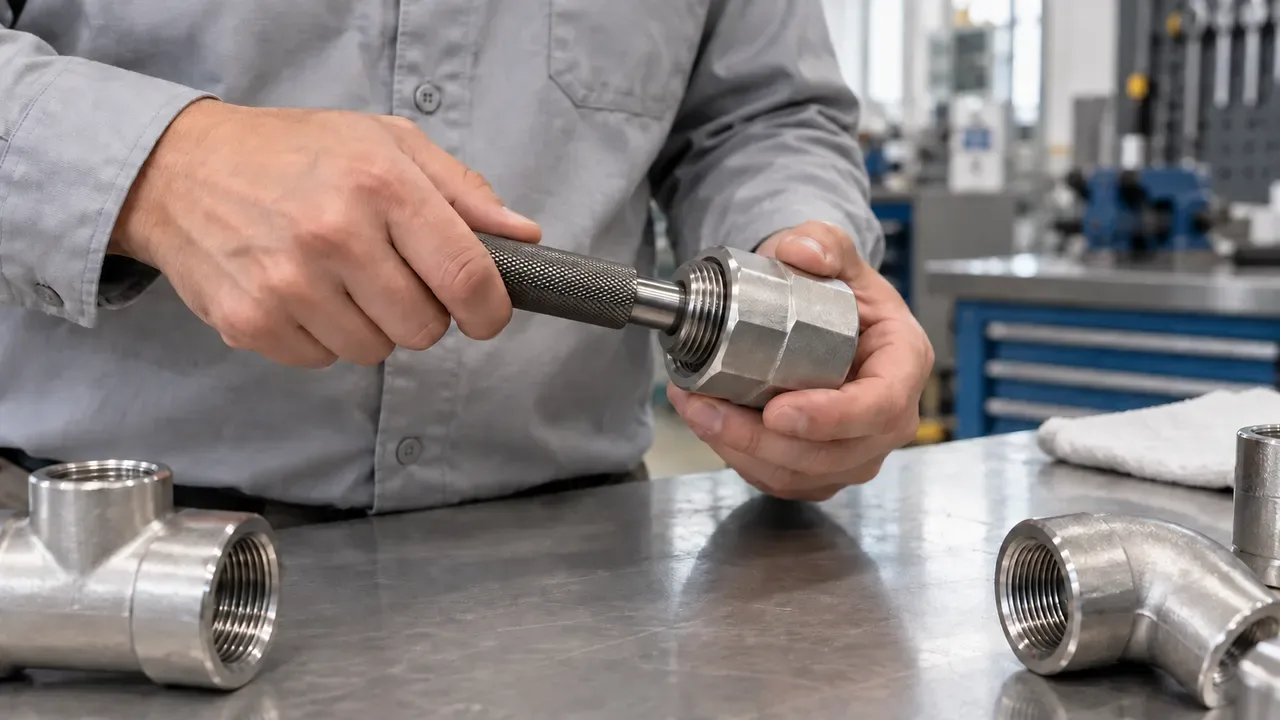
Ask which checks are done on every fitting and which are done on a sample. Casting can leave porosity, and a pore that runs from the inside surface to the outside becomes a leak path. The answer tells you how much of the checking happens before the parts reach you.
When molten metal solidifies, it shrinks, and that shrinkage can leave voids. Godfrey & Wing, a leak test equipment maker, describes how porosity that connects the two surfaces of a casting will leak under pressure, and why higher-risk parts move from sampling to 100% testing.
At our plant, every fitting is checked for dimensions and thread before it ships, and pressure testing is done on samples. Ask any supplier for the same breakdown, and write the answer into the purchase terms.
Three questions bring out a precise answer:
- Is the pressure test 100% or sampled, and at what stage?
- How is the thread checked: by gauge on every part, or by sample?
- What happens to a part that fails? Scrapped, or reworked and retested?
6. Paperwork: which material document you will get
Ask which material document ships with the order, by name, before you pay. "We can provide a certificate" covers everything from a one-line declaration to a traceable test report. The type of document decides what you can prove later.
A mill test report (MTR) records the chemical and mechanical properties of the material a part was made from. In Europe and in many export specifications, material documents are classified under EN 10204. A type 3.1 inspection certificate under EN 10204 is issued by the manufacturer's inspection representative, who must be independent of the production department. It states compliance with the order and gives actual test results that trace to the heat or lot delivered. The same source describes it as the document most often requested for pressure equipment and process piping.
We supply a mill test report for the body material on request. Tell us at the time of order and it ships with the goods. If your project calls for a specific document type, name it in the RFQ so the quote covers it.
7. Range: can one factory cover the whole bill of materials?
Ask whether the factory makes every shape and size on your list, and ask for the exceptions in writing. Mixing suppliers inside one pipe run means mixing tolerances, thread cutting and material sources. One factory for the whole set keeps the joints consistent.
Our threaded range covers 90 and 45 degree elbows, street elbows, equal tees, crosses, unions, hex nipples, caps and full couplings in 202, 304 and 316. Sizes run from 1/8 inch to 4 inch, with one exception we state up front: the cross stops at 3 inch. Reducing tees are made to order. The full range, with the valves that usually go on the same line, is on our products page.
8. Who actually makes it
Ask for the plant address, the headcount and the processes done in house. A trading company can be a good partner, but you should know when you are talking to one. When a problem comes back from the field, the person who can fix it is the one who runs the casting and the thread cutting.
We are the manufacturer. The plant was set up in 1995 in Longjing, Taichung, Taiwan, has 150 people on the floor and turns out more than 20 million pieces a year. The factory holds ISO 9001. More on the plant is on our About page, and our OEM page covers private label and custom marking.
Common mistakes on first orders
Most problems with a new fittings supplier start in the RFQ. Each of these is cheap to prevent and expensive to fix after delivery.
- Leaving the thread off the RFQ. The factory quotes its standard thread, the buyer assumes NPT, and the mismatch shows up on site.
- Comparing quotes that name different grades, or no grade at all. The cheapest line on the sheet is often a different alloy.
- Reading "Class 150" as "150 psi". The class is a rating designation tied to a standard and a temperature, not a pressure number.
- Accepting "certificate available" without asking which document. A declaration and a traceable 3.1 certificate are not the same paper.
- Mixing grades inside one line, usually a 304 fitting slipped into a 316 run during a repair.
- Splitting one pipe run across two or three suppliers to save a few cents per piece, then chasing thread fit problems between them.
How to send an RFQ that gets a straight quote
A complete RFQ gets a comparable quote on the first reply. Put these seven items on it and any competent factory can price it without a round of questions.
| Item | Example |
|---|---|
| Shape | 90 degree elbow, female both ends |
| Size | 1/2 inch nominal |
| Grade | 316 |
| Thread | NPT, or PT |
| Quantity | Per size and shape, plus expected annual volume |
| Documents | Mill test report, or the specific document type your project needs |
| Marking and packing | Standard, or your brand for private label |
Send the list, a drawing or a photo through our contact page. Request a Quote — reply within 24 hours →
FAQ
How do I know if a stainless steel pipe fittings manufacturer is a real factory?
Ask for the plant address, the number of people on site and which processes happen in house: casting, thread cutting and testing. A manufacturer answers without checking with anyone. Then ask a technical question about your own order, such as how the thread is gauged or whether the pressure test covers every piece. A trading company has to forward that question. A factory answers it on the call. A video walk-through of the casting area is a reasonable request before a first order.
Is PT thread the same as NPT?
No. PT is the Japanese designation for the 55 degree taper pipe thread also described as BSPT, R and Rc. NPT is the North American taper pipe thread with a 60 degree angle and a different thread form. The two do not seal together even when the nominal size is the same. Put the thread standard on the purchase order by name, and check the first delivery with the correct gauge before the parts go into stock.
Should I choose 304 or 316 stainless steel fittings?
Use 316 wherever chlorides are present: brine, seawater spray, coastal sites, washdown areas and most chemical service. The molybdenum in 316 is what helps it resist chloride pitting. For general water and compressed air, 304 is the usual choice at a lower price. Whichever grade you pick, keep the whole line in that grade, because a single fitting in a lower grade becomes the first place corrosion shows up. If your specification allows 202, confirm it in writing and quote it as its own line.
Does Class 150 mean the fitting is rated to 150 psi?
No. Class 150 is a rating designation, not a pressure limit. The pressure a fitting can hold depends on the standard the class belongs to and on the service temperature, and it changes as temperature rises. For corrosion-resistant threaded fittings, MSS SP-114 is one standard that defines Class 150 and Class 1000 with their own pressure and temperature ratings. Ask your supplier which standard applies and for the rating at your operating temperature.
What documents should come with stainless steel pipe fittings?
At minimum, a mill test report for the body material, showing chemistry and mechanical properties. Many export and pressure piping specifications ask for an EN 10204 type 3.1 inspection certificate, which is signed by an inspector independent of production and traces test results to the heat or lot delivered. Name the document type in your RFQ rather than asking for "a certificate", so the quote includes it and the paperwork arrives with the goods.
Summary
Choosing between stainless steel pipe fittings manufacturers comes down to eight checks: the grade on the quotation line, the thread on the purchase order, what the pressure class refers to, how the bodies are cast, whether every piece is tested, which document ships with the order, whether one factory covers the whole list and who actually runs the plant. None of them take long to ask, and each answer goes straight onto the purchase order.
We shell mold cast our threaded fittings in 202, 304 and 316, stock PT threads, make NPT and other threads to order, check every piece for dimensions and thread, and pressure test on samples. If you are lining up a supplier for threaded stainless fittings, send your list and we will quote it line by line.