
One piece ball valve, reduced port, manual or pneumatic
A one piece ball valve with a welded 316 body — there is no threaded joint in the middle to work loose. Manual in two end builds from 1/4″ to 2″, or a 1/2″ pneumatic build with the ISO 5211 pad cast straight into the body. 304 or 316, PTFE seats, 1000 WOG.
Built to hold, built to last.
The body is formed as a single piece. There is no joint in the middle of the valve at all — nothing welded, nothing screwed together — so one of the places a line can start to weep simply is not there. The trade-off is honest: a one-piece body cannot be opened up, so when the seat is finally worn the valve is replaced rather than rebuilt.
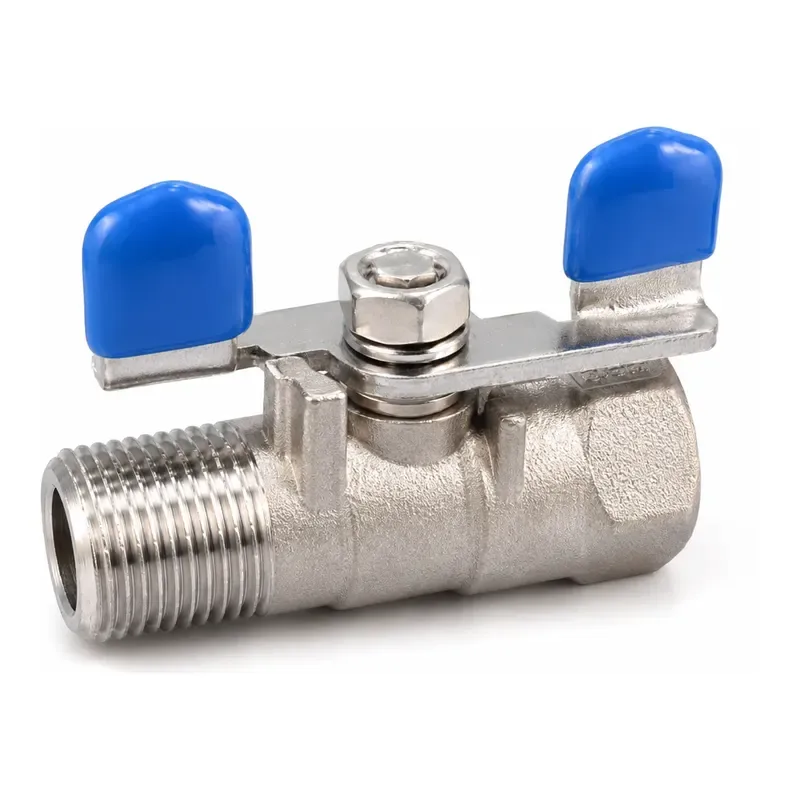
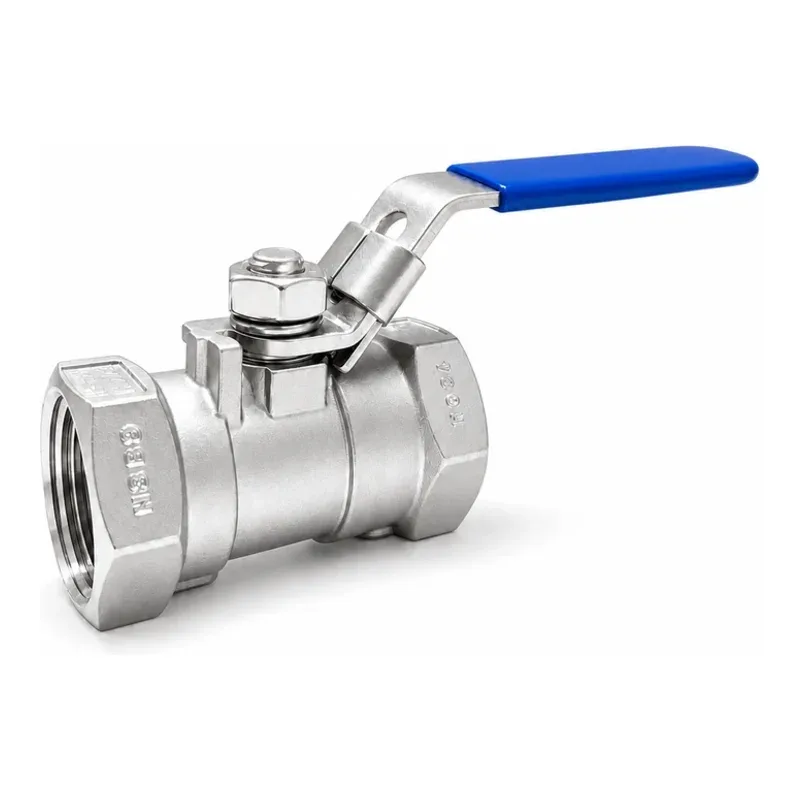
Two end builds cover different jobs. Male × female comes in 1/4″, 3/8″ and 1/2″: one end screws straight into a female port, so you save a fitting and shorten the assembly where there is no room for one. Female × female runs 1/4″, 3/8″, 1/2″, 3/4″, 1″, 1-1/4″, 1-1/2″, 2″ and 3″ (there is no 2-1/2″), and drops into an existing threaded line like any inline valve — it is the only build that goes above 1/2″.
It earns its place where a full-size valve simply will not fit — instrument and gauge lines, utility shut-off on water, oil, gas and air, and OEM machinery built to a tight envelope. The bore is smaller than the pipe: this is a reduced port valve, which is what keeps the body compact.
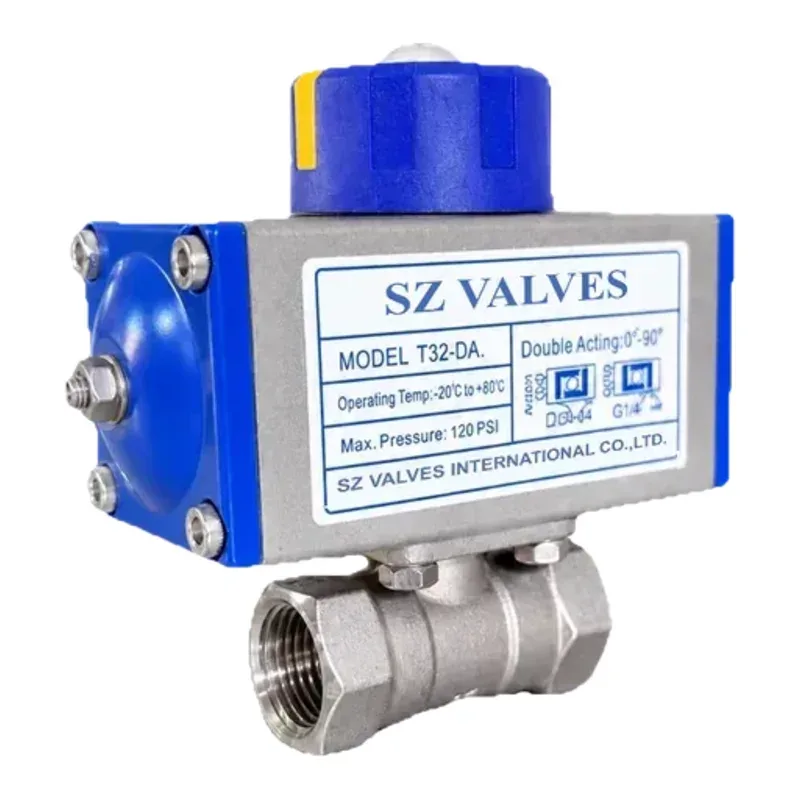
The same body is also built as a pneumatic valve. On the 1PC-PN the ISO 5211 mounting pad is cast into the one-piece body itself, so the rack-and-pinion actuator sits straight on the stem — no bracket to flex, no coupling to misalign, and a shorter, stiffer assembly than the usual valve-plus-bracket stack. The aluminium actuator comes double acting or spring return, runs on 4–8 bar clean dry air, and takes a NAMUR solenoid directly. It is an on/off isolation valve, not a modulating one.
- R1BN
- R-1B
- 1PC-PN
- Body
- 316 stainless
- 316 · 304 stainless
- 316 stainless
- Made to order
- 304 stainless — made to order
- —
- —
- Size range
- 1/4″ · 3/8″ · 1/2″
- 1/4″ – 3″
- 1/2″
- Thread
- Male × female
- Female × female
- PT (taper) thread
- Other threads
- PT taper · NPT · PF
- PT taper · NPT · PF
- PT taper · others made to order
- Seat
- PTFE
- PTFE
- PTFE
- Pressure
- 1000 WOG
- 1000 WOG
- 1000 WOG
- Temperature
- −20°C to 180°C
- −20°C to 180°C
- −20°C to 180°C (valve)
- Air supply
- —
- —
- 4–8 bar (58–116 psi)
- Port
- Reduced port
- Reduced port
- Reduced port
- Surface finish
- Pickling
- Pickling
- —
- Operation
- Manual quarter-turn
- Manual quarter-turn
- Pneumatic — DA or SR, on/off
Built for essential flow control.
Every valve leak tested.
Each unit is checked for leakage before shipment.
What is the maximum working pressure?
Rated 1000 WOG. That is a cold, non-shock rating for water, oil and gas — it is not a steam rating. Tell us your line temperature and we will confirm the valve suits it.
What is the operating temperature range?
−20°C to 180°C.
What sizes are available?
Male × female in 1/4″, 3/8″ and 1/2″. Female × female from 1/4″ to 2″: 1/4″, 3/8″, 1/2″, 3/4″, 1″, 1-1/4″, 1-1/2″ and 2″. 2-1/2″ and 3″ female × female are available on request — ask and we will send the dimensions.
Male × female or female × female — which do I need?
Choose male × female when one side of your connection is a female port and you want to save the adaptor; it is available in 1/4″, 3/8″ and 1/2″ only. Female × female is the general-purpose build and the only one that goes above 1/2″.
Which thread standards do you supply?
PT taper thread is the standard. NPT and PF are also available — tell us which you need.
Can the valve be opened for repair?
No. The body is one piece, so it cannot be taken apart — that is the trade-off for having no body joint to leak. If you need in-line servicing, the three-piece ball valve is the one to use.
Is there a pneumatic version?
Yes — the 1PC-PN. Same one-piece 316 body and PTFE seats, in 1/2″, with the ISO 5211 pad cast into the body so the actuator bolts straight on. No bracket and no coupling.
Double acting or spring return — which should I order?
Double acting (DA) uses air for both strokes and is the economical default. Spring return (SR) drives one way with air and the other with springs, so on air failure the valve moves to a known position. If the line must fail safe, order SR.
What air supply does the pneumatic build need?
4–8 bar of clean, dry air.
What is the temperature range on the pneumatic build?
The valve body is rated −20°C to 180°C. The standard actuator is rated −20°C to +80°C, so the assembly follows the actuator on hot lines — tell us your line temperature and we will confirm the build.
Can I add a solenoid valve or limit switch to the pneumatic build?
Yes. The actuator takes a NAMUR solenoid directly, and a limit switch box can be fitted on top.