
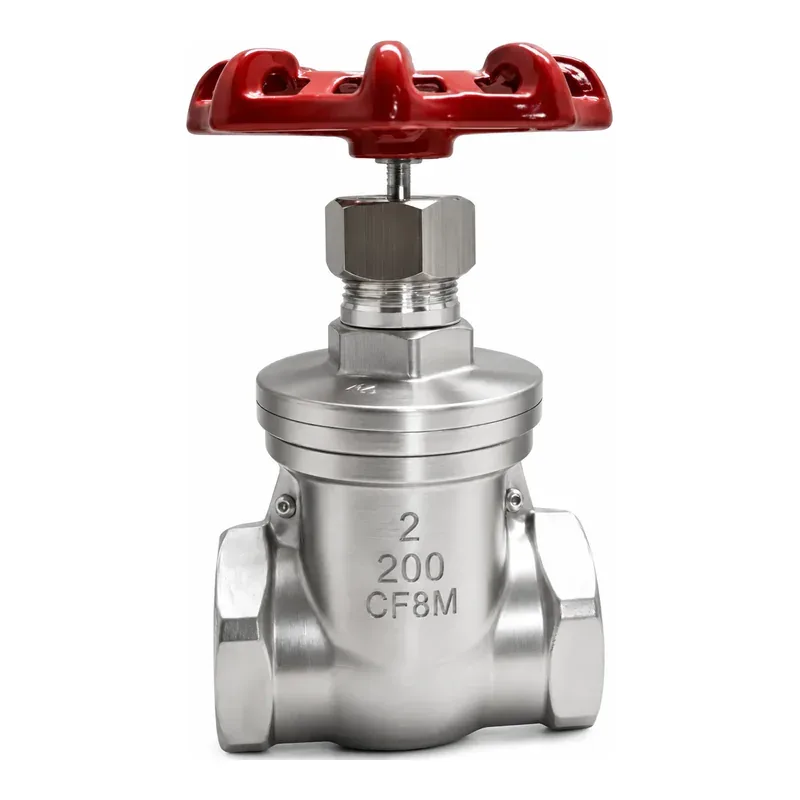
Threaded Gate Valve — Rising Stem, 316 Stainless
A threaded gate valve in cast CF8M (316) stainless steel, sizes 1/2″ to 2″ with female PT threads. The multi-turn handwheel lifts a solid gate clear of the bore — full flow when open, slow closing that avoids water hammer. The stem rises as it opens, so you can see the valve position from across the room. 200 WOG, PTFE packing.
Open all the way. See it from anywhere.
A gate valve does one job: it opens the line all the way, or shuts it completely. Wind the handwheel and the solid gate lifts clear of the bore, leaving a straight, unobstructed path — the flow loses almost nothing passing through. Wind it down and the gate closes slowly, which is exactly what you want on a water main: no slam, no water hammer.
This is the GT series from our line as a Taiwan gate valve manufacturer: a cast CF8M (316) stainless body with female PT threads, PTFE packing, 200 WOG, designed to ANSI B16.34 and tested to API 598. Six sizes cover 1/2″, 3/4″, 1″, 1-1/4″, 1-1/2″ and 2″ — dimensions for every size are on the sheet above.
The rising stem tells you what the valve is doing As the gate opens, the stem rises out of the handwheel; as it closes, the stem sinks back down. That makes the valve position readable at a glance — no guessing whether a line is live before you break into it. It is the same reason plant utility mains and pump isolation points have used rising-stem gates for decades.
An isolation valve, not a control valve A gate valve is meant to run fully open or fully closed. Held half-open, the gate vibrates in the stream and the seats wear — industry guidance is consistent on this. Use it where the line stays open for long stretches and gets shut for service; when you need frequent quarter-turn shutoff or flow control, that is ball valve territory, and we build those too.
- Model
- J41W-200R
- Body
- Design ANSI B16.34 · Test API 598 (shell 2.0 MPa / seat 1.6 MPa)
- Size range
- 1/2″ – 2″ (DN15 – DN50)
- Other threads
- Female PT (taper pipe) thread
- Seat
- PTFE gasket, PTFE V-ring packing
- Pressure
- 200 WOG (200 psi)
- Temperature
- −20 to +80 °C
- Operation
- Multi-turn handwheel, rising stem
Where it gets used
Every valve leak tested.
Each unit is checked for leakage before shipment.
Gate valve or ball valve — which should I use?
A gate valve suits lines that stay fully open for long periods and close for service: it gives a straight full-flow path and closes slowly, which protects water mains from hammer. A ball valve suits frequent operation — quarter-turn, instant shutoff. If you operate the valve daily, look at our ball valves instead.
What does "rising stem" mean?
The stem physically rises out of the handwheel as the valve opens and sinks as it closes, so the valve position is visible from a distance. It is the standard choice where operators need to confirm a line is shut before working on it.
Can I use a gate valve to throttle flow?
No. A partially open gate vibrates in the flow and wears the seats. Run it fully open or fully closed; for flow control use a valve designed for it.
What pressure and temperature is it rated for?
200 WOG — 200 psi cold working pressure for water, oil and gas — across −20 to +80 °C, with PTFE packing. Shell and seat are tested to API 598 at 2.0 MPa and 1.6 MPa. If your line is steam, tell us the service conditions first.
What sizes do you make?
Six sizes: 1/2″, 3/4″, 1″, 1-1/4″, 1-1/2″ and 2″, all with female PT threads. Full dimensions for every size are in the dimension sheet on this page.